
June 23, 2010

Hillside gravel and timber path–done!

Filed under: 2nd garden--2010, Design, Gates, How I did it, Paths — Pam/Digging @ 10:31 am


What joy in the completion of a long-delayed project! I’m not speaking of the narrow side garden itself, which is quickly filling in under the blazing sun’s heat, but the gravel-and-timber pathway that leads you through the sloping garden.


I rarely pass up a chance to show before-and-after pictures, finding them inspiring myself. So here’s a before of a typical side-yard lawn, looking up-slope from the back yard toward the front. We’d already installed a new fence at this point, pushing the gate forward about 25 feet and therefore extending the deer-proof back garden. I had sprayed out the lines of a pathway through the space and just started digging out new beds on either side of the path.


Eight months later the new garden is growing, and it’s time (way past, actually) for the path to go in. This time I hired out the grass removal, making sure they left the edging stones I’d hauled over from the surplus at Austin Memorial Cemetery (free for the taking). I tried out a 6×6 treated timber post for size up by the gate but realized it was too tall for my intended sloping steps.


I ended up using 4×4 treated posts, which I cut to fit with a circular saw. I drilled a half-inch hole near the ends of each cut post and pounded in an 18-inch length of three-eighth-inch rebar to secure the posts to the ground.

A trip to Whittlesey Landscape Supplies enabled me to pick out a washed pea gravel in buff shades (not glaring white), and I found a landscaper there who was willing to handle the small job (for him, not me!) of picking up and delivering one and a half cubic yards of pea gravel, shoveling it in a wheelbarrow, rolling it 50 feet downhill, and spreading it in the spaces between the treated posts.


And here’s the same sequence of before-and-afters, looking down-slope: Pathway defined and new beds being dug out. That purple-leaf acacia tree, by the way, didn’t survive our hard freezes last winter, and I’ve replaced it with an Anacacho orchid tree.


After: The grassy path has been dug out, and treated timbers are secured to the ground approximately 6 feet apart.


Done! Several inches of pea gravel have filled in the “steps” and given the path a neat, finished appearance. This path is not heavily used, but I am curious to see how the gravel holds up along the slope after some foot traffic.

On a separate subject, a regular reader has told me that she’s been having trouble leaving a comment on my site for some time. I have had no other indication of trouble with my comment field, so I’d appreciate it if anyone else who’s been having difficulty could let me know what’s happening. Thanks!

All material © 2006-2010 by Pam Penick for Digging. Unauthorized reproduction prohibited.

May 31, 2010

Laying a stone path

Filed under: 2nd garden--2010, How I did it, Paths — Pam/Digging @ 5:14 am


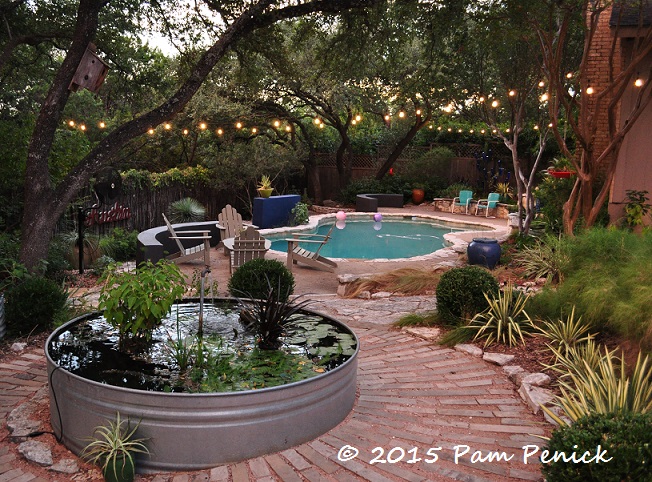
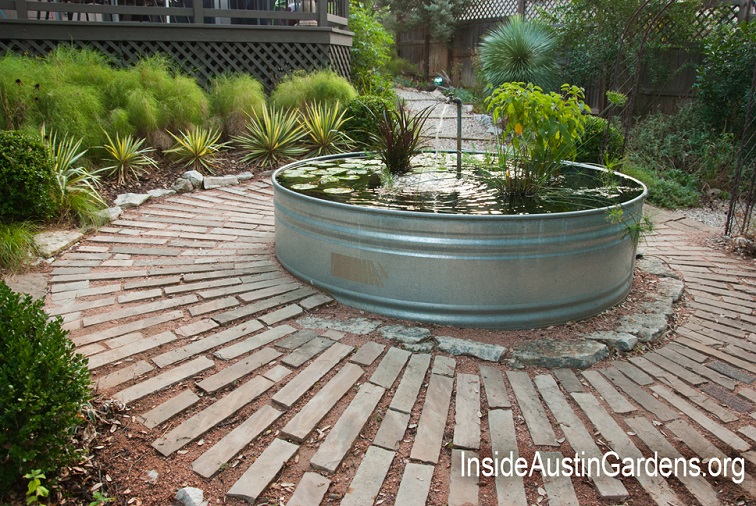
Having procrastinated on those grass paths in the back garden long enough, this weekend I hauled home two trunkloads of limestone pieces and got to work. Naturally, I ran out of stone while laying the path on Sunday, and I knew the stone yards would be closed through Tuesday. Meanwhile we have company coming over today, and I couldn’t leave it half-finished. So I used some of my leftover stone strips from the sunburst path around the stock-tank pond and made a diamond-shaped insert. A biscuit-like river rock in the middle is the finishing touch.


Making a path like this is pretty easy—meaning it doesn’t require a lot of technical skill, but it does require a strong back and plenty of sweat equity when temperatures are in the upper 90s (35.5 C). After digging out the grass, a chore I hired out, I spread 3-4 inches of paver base and used a tamper to compact it.


Then I put down a couple of inches of sand.


Next I laid the stone. It’s best to use stone that’s at least two inches thick when dry-laying (rather than mortaring) a walk; it’s less likely to lift up on one end when you walk on it. Fitting the stone together takes patience. It’s kind of like putting together a puzzle. I checked to make sure each piece was level with the others as I went along. An existing slope ensured that water won’t pool on the path when it rains; if the space had been flat, I’d have built in a slight slope.


When the stone was laid and level, I swept sand across it and filled the cracks. That’s it.

I’m happy to have a firm, level path from the deck to the garden. Next up: the sloping side-yard path. There’s always another project.

All material © 2006-2010 by Pam Penick for Digging. Unauthorized reproduction prohibited.

April 2, 2010

Cattle panel plant support for Senorita Rosalita cleome

Filed under: 2nd garden--2010, How I did it, Plant trial, Tools, Xeric plants — Pam/Digging @ 6:19 am


If recent tweets among Austin garden bloggers are any indication, we’ve snapped up pot after pot of ‘Senorita Rosalita’ cleome at the Natural Gardener and at Home Depots all over town this spring, and I made sure to grab two for myself in the buying frenzy. Last year I trialed this Proven Winners annual (perennial in zones 8-10, but it didn’t survive our hard freezes), and it performed spectacularly through record heat and drought, growing big and bushy in part sun and flowering spring through fall. You couldn’t find ‘Senorita Rosalita’ cleome in area nurseries or garden centers last season, but this year, to my delight, it’s available. It’s also offered online at White Flower Farm.

It’s a great plant. The only problem I’ve documented with it is splitting after a heavy rain. One of last year’s cleomes split right in half, leaving a gaping hole in the mass of foliage. So this time I’m giving the Senoritas some support.


I saw this idea at the Wildflower Center last winter (above) and decided to try it at home. I cut a long section of cattle-panel wire to a width of 3 squares, and on each end I snipped the cross pieces off to a length of 2 squares, creating staking legs. Holding the wire upright and then bowing it away from me, I stood on one end of it and bent the wire into a U-shape. Centering it over the cleome, I pushed the staking legs into the ground.


I considered painting the wire a fun color, as Lindy McGinnis did with cattle-panel trellises I saw in her garden on tour. But since I have a galvanized-silver thing going with all my stock tanks, I opted to leave the wire as-is and let it blend into the background.

I made another support for my ‘Ava’ agastache, which is also prone to splitting, according to High Country Gardens owner David Salman (see his comment on my agastache post, linked above). Cattle panel is a sturdy wire, and as the cleomes and agastache grow up through the holes, their top-heavy stems will be supported.

Cattle panel is a fantastic material for gardening projects like trellises, screens, and fencing. It comes in 10-ft. lengths and can be purchased at Callahan’s General Store in Austin, which is also where I buy my stock tanks. You need to use bolt cutters and arm muscle to snip it, and it’s a good idea to wear gloves when handling it, as the cut edges are sharp.


In my former garden I used a full piece of cattle panel to construct a trellis screen to divide my garden. Click for my how-to. When I moved, I disassembled that screen and brought the wire panel with me, which I used to make my plant supports. That’s the other great thing about cattle panel: it’s easily repurposed for the next project.

All material © 2006-2010 by Pam Penick for Digging. Unauthorized reproduction prohibited.

August 17, 2009

Separating agave pups is ruff but doggone rewarding

Filed under: 2nd garden--2009, Containers, How I did it, Stock tanks, Xeric plants — Pam/Digging @ 11:20 am


When you grow agaves, mangaves, and aloes—which love our Texas summers—you often get pups. That’s what you call the baby plants that grow up under or beside the mother plant’s leaves. Not all agaves produce pups (the ‘Whale’s Tongue’ does not), and that can be a plus if you want a specimen plant that requires almost no maintenance. But getting pups, like this litter on my ‘Macho Mocha’ mangave, can mean a never-ending supply of free plants for your garden or those of your friends.

This weekend I tackled the de-pupping of the mangave. It was looking messy with all those pups poking out and getting taller and taller, and I’d noticed that the mother plant was looking tired and a bit saggy since it bloomed. Perhaps removing the rapidly growing pups from her root system will help to revive her energy level. (Mangave ‘Macho Mocha’, unlike agaves, is not monocarpic and survives after blooming.)


De-pupping a spiky agave is dicey work, but that wasn’t the difficulty with the soft-leaved ‘Macho Mocha.’ Rather, the mangave’s broad, heavy leaves must be lifted to get to the pups, and they are brittle and easily broken. I enlisted my daughter to help me. We both wore gloves to protect our hands from the rough edges of the leaves, and she carefully lifted the leaves out of the way while I reached under and attempted to snip the pups free of the mother plant.

It wasn’t easy, and the pups clung tenaciously, like little pit bulls. Sweaty and mosquito-bitten, I started tugging on the pups, pulling them free with brute force. Some came out with good root systems intact, while others were snapped off at the base. But at last the pups were all unleashed, and the mother plant looks clean and spiffy again.


And see all the mangave pups we potted up? I have a ‘Macho Mocha’ kennel!


Next up for a de-pupping was my squid agave (A. bracteosa). It produces solitary pups from time to time (not visible in this picture).


I’d already transplanted one pup a while ago.


I pulled the latest pup out and got a nice, long tap root. The root was too long to be easily planted, so I made a clean cut under one of the root hairs and planted it in a good-draining mix of soil and decomposed granite. Squid agave, like the ‘Macho Mocha’ mangave, prefers partial shade in our hot climate, which makes it perfect for my live-oak-shaded garden.


I picked up these lovely Aloe saponarias at The Great Outdoors recently, when all their plants were on sale for 50% off. While I was planting pups this weekend, I also moved some sun-scorched irises to a morning-sun location and replaced them with these sun-loving aloes. Backed by feathery bamboo muhly (Muhlenbergia dumosa) and fronted by Dalhberg daisy (Thymophylla tenuiloba), it’s a combo made for sun and heat.


Aloe saponaria, an African native, is cold-hardy in Austin, and it puts up stalks of tubular flowers in spring. It also produces a LOT of pups. When these begin to pup, I plan to remove them regularly to keep the single-star look.


Speaking of aloes, I also planted this big Aloe striata, which I picked up at Oracle Gorge’s recent plant sale. This is a new plant to me, and I have no idea whether it pups or not.


It’s a beauty, though, with those pink margins along the stripey leaves.

All material © 2006-2009 by Pam Penick for Digging. Unauthorized reproduction prohibited.

Older Posts »

Powered by WordPress
All material © 2006-2010 Pam Penick. Unauthorized reproduction prohibited.