

What to do about frozen agaves & other plants
The deep freeze of the South has retreated, and now it’s time to assess the damage done to our plants. Native and well-adapted perennials and shrubs should be just fine, even if they look toasted. The best bet is to leave them alone for now, brown stalks and all, because pruning will stimulate new growth, and we’re likely to have more freezes. A good rule of thumb for central Texas is to cut back perennials (salvias, Turk’s cap, plumbago, coneflowers, etc.) and ornamental grasses around Valentine’s Day in preparation for new spring growth.
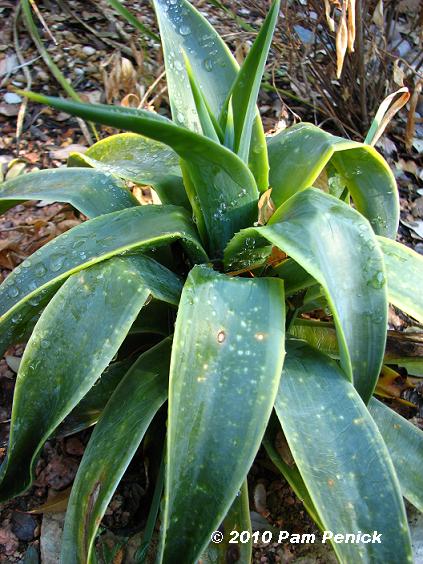
Freeze-damaged Agave desmettiana ‘Variegata’
Many Austin gardeners, myself included, love to push our zone 8b with plants that are hardy in zone 9 or even 10. In recent mild winters all we had to do to protect these cold-tender plants was toss a sheet over them when an occasional light freeze was predicted. This year temps plunged into the mid-teens or even lower in the Hill Country west of Austin, and a sheet may not have provided enough protection. Now we’re looking at mushy agaves, aloes, and other pitiful plants.
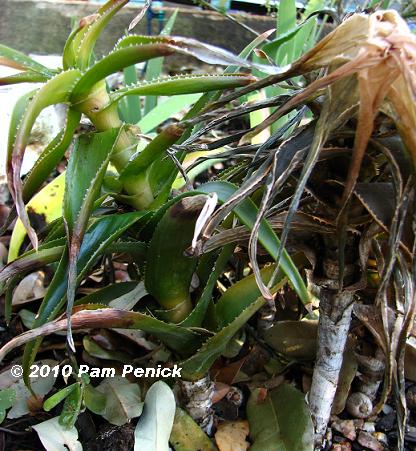
Freeze-damaged Aloe ciliaris
If you’re tempted to rip out everything that looks wilted and mushy, wait. There’s a chance that tender growth in the center was protected and is still being protected by damaged leaves up top. Even agaves that are severely stressed but not dead may respond in spring by producing pups that can be used to replace the mother plant.
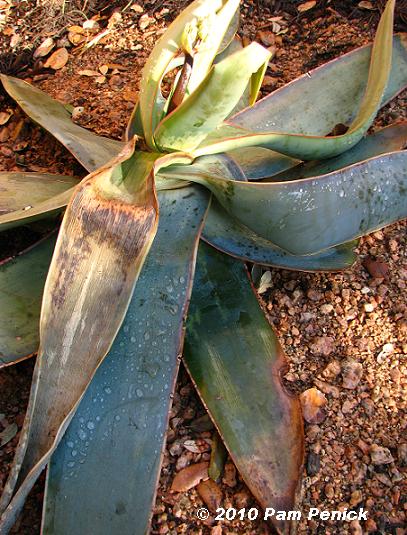
Aloe striata with freeze-damaged leaves
Here’s what Daphne Richards, our County Extension Agent, has to say about hasty garden clean-up on the Central Texas Gardener website:
What should I do about my frozen plants, especially my agaves?
We’re a little colder than we’re used to this early, although probably not historically all that cold.
Many of us have planted desert plants, like agaves. Some of them got pretty mushy in our recent freeze, especially if they’re from a low desert area. The mushy leaves will not recover.
What I would recommend: don’t remove it at this time. If the center of the plant still has firmness to it, I would leave it and see if it makes pups next year. That way you can actually save the plant and start over with its pups.
You can remove the summer annuals that froze. Cut back frozen woody perennials.
But if you just have frost bit tips on herbaceous perennials, it’s best to leave them for now, until the plant starts growing again. Trimming out the frozen tips will encourage growth in our typical warm spells in winter. Then, when we get another freeze, the plant will be stressed.
Don’t be too anxious to do a lot of cleanup just yet, except for annuals, frozen woodies and confirmed mushy plants.
Daphne Richards, County Extension Agent-Horticulture, Texas AgriLife Extension Service
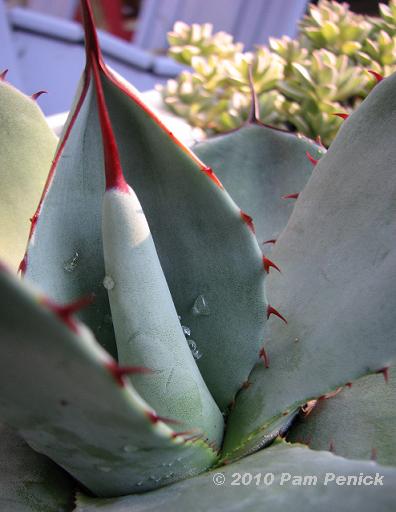
Agave parryi truncata, undamaged after being covered
It’s hard to be patient when your garden looks brown, wilted, and mushy. But procrastination pays off if it prevents further freeze damage and helps your plants recover.
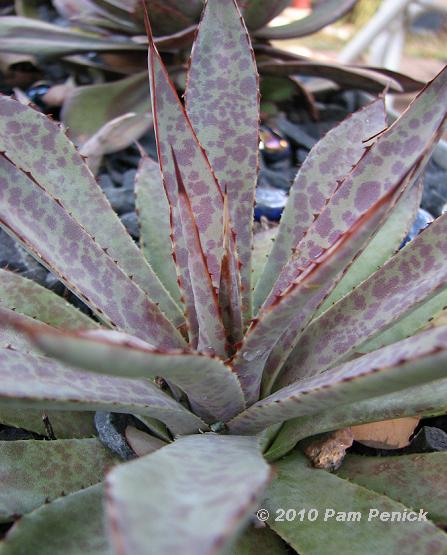
Mangave ‘Bloodspot’, undamaged after being covered
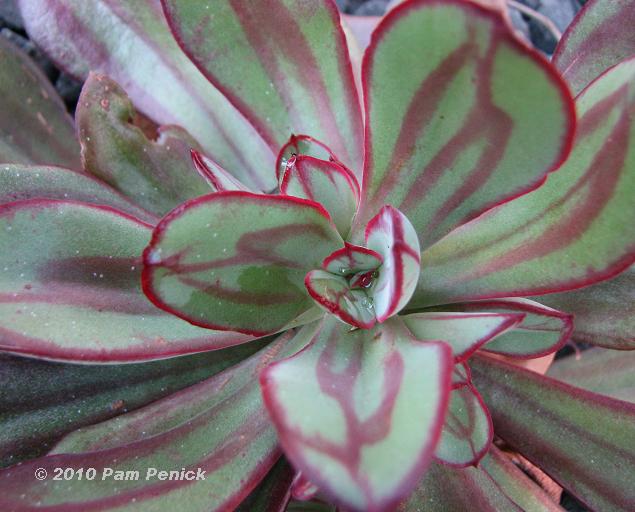
By the way, can anyone ID the succulent in the very first photo? I think it may an Aeonium. The first-pictured plant is Echeveria nodulosa (thanks for the ID, Peter, Noel, and Debra!). I bought three of them on sale last fall at Home Depot or Lowe’s, unlabeled, and put them in my washtub planter. I was sure they’d freeze to mush during our cold snap, but protected by the overhanging branches of a live oak and covered with a sheet, they seem just fine.
All material © 2006-2010 by Pam Penick for Digging. Unauthorized reproduction prohibited.
This is a great post, and I wish I had known about leaving mushy agaves sooner. I pulled some out last spring because they burst in the winter, but maybe I should have left them to see if they would make pups. Thanks for the info!
Thanks, Pam! I have a lot of succulents on my balcony that got mushy and I was just about to pull them out and throw them in the compost. Some of them are new to me, so I may leave them for now and see if the root structure is still viable enough to put out some new growth in a few months.
Thanks for posting this Pam. I’ll have to see if my Agave desmettiana has a firm core. Right now the plant is kind of dark green and brown, a little worse looking than yours, so it may not have made it. I don’t know if that’s an aeonium in the first photo as it’s way different than mine. I have/had Aeonium arboreum v. atropurpureum ‘Zwartzkopf’ in my stock tank and the leaves are wrinkled and the stems are folding over on themselves. So it didn’t stand up as well to the weather as yours. I love how hardy that A. parryi is and it’s looks. I’ve always loved them and may have to try that one instead (pushing that 8a boundary I know!).
Definitely not an aeonium. Its Echeveria nodulosa. Good advice about cold plants!
Hello Pam,
Wonderful advice. Although we have not experienced the intense cold as you have, we do have the normal frost damaged growth on shrubs and perennials. I would love to confiscate all pruning equipment from my clients until later in the winter to keep them from pruning off frost damaged growth too early 🙂
Such a shame about your cold-damaged plants. It’s so hard to imagine that Austin, with its sweltering summer temps, can have such a hard cold snap. I hope you’re able to salvage some of them at least.
Ha, your post made me laugh a bit as everything turns brown or mushy or very dead looking over here every winter. Wait and see is the best advice. Most gardeners will be amazed to find how many plants have actually survived, I know I always am come Spring.
I just came in from assessing the damage and that’s pretty much what I’d already decided to do…. am a strong believer in wait and see and think you and Daphne are giving us good advice!
It was shocking to see what wimps my aloes were, even clustered with other marginal plants in a protected cove against the house wall under layers of covering. The other plants look like they’ll make it, but the aloes are mush.
Annie at the Transplantable Rose
aloha pam, aaaaaaw what a yucky mess….i don’t miss those days when i had those cold freezes back where i came from and i had to dig out all my most precious succulents and put them all (the entire garage) in a safe haven.
btw, the first plant is an echeveria, i’ll have to dig up what the name is, i originally though it was also an aeonium and had a succulent specialist give me the name, but that was awhile ago, i’ll get back to you on what this is when i can recall the name.
great post, i would recommend putting mulch, leaves over your succulents if your too lazy to cover with a cloth overnight and even put out some xmas lites to warm up your tenders….:)
I am glad you gave this advice to others and hope you many of your plants are saved. Agaves and succulents can be so resilient, once the core or stemis healthy they oftem come back-once my garden was invaded by snails which ate a dozen new agaves and succulents-luckily time restrictions meant I did not throw our the lot-and indeed many regrew/pupped.
So it sounds like you are advocating patience? Never easy…
Hi, Pam — Yes, that’s Echeveria nodulosa in the first photo. Such an unfortunate name for such a lovely plant!
One thing to keep in mind is that the frost-damaged, fleshy leaves of succulents such as agaves, if not removed, may induce rot in healthy tissue. It’s important to protect the plant’s inner core, because that’s where the new growth emerges. So letting collapsed, squishy leaves remain on the plant may actually make matters worse. Agaves go dormant in winter, so you won’t see new growth until spring. And of course, keep them dry. They hate being cold and wet!
Good points, Debra. Thanks for adding your helpful tips. —Pam
Good advice! I have some very badly damaged night blooming cereus I was ready to toss. I may wait and see now.
Any advice on a Dychia that has pupped? It was protected indoors in a pot, so freezing isn’t an issue. It’s one of those really thorny types that Yucca Do sells and I just noticed it has many little pups. I’d like to separate them, but I’m not sure how. Where does it come apart? How do I handle it carefully without uprooting the whole thing? What about all those dang thorns?
How do you handle it, Chris? Very carefully! (You knew I was going to say that, didn’t you?) Wear thick gloves or wrap the plant in an old towel. I usually pinch off pups by pulling them gently to expose the root that connects them to the mother plant and then snipping the root with a pair of pruners. You will probably only need a few root hairs to get the pups growing. As with agaves, I would wait to de-pup or plant until freeze danger is past. If kept indoors, perhaps that won’t matter. —Pam
I am having a hard time wrapping my head around the fact that Austin, parts of northern Florida and many other “warmer” places have gotten colder than us this year. My lowest low so far was two nights ago at 20. We have been blessed and spared from so much the rest of the country has experienced. I love the Echeveria in the first shot, looks good enough to eat.
Thanks to you and Daphne for this excellent information. My agave not ovatifolia and all the sedums did fine, but a passalong aloe with orange blooms turned to mush; thankfully, the core appears intact. Now I’m hopeful it will come back! The USDA zones confuse me. Zone 8 plants can’t take our heat; zone 9 plants freeze. What’s an 8b gardener to do, I ask ya?
Tell me about it! All we can do is keep on keepin’ on, Caroline. —Pam
Pam, what about your big specimen agave, the Whale’s Tongue, I think you call it? Is it okay?
The ‘Whale’s Tongue’ is fine and dandy, Carol. It’s a pretty cold-tolerant variety. —Pam
As usual, your photos are so lovely. I especially love the Agave parryi & Echeveria nodulosa…what color! I hope you didn’t have too much damage.
When I read this post yesterday I realized I had not check any of my plants. All are in posts and I keep them in a small puptent in the winter. They have always done very well. Unfortunately this is not the case. I am kicking myself and wanted to cry as a lot of my cactus and succulents were mush. Not all were lost but these are plants that I have accumulated over time. Either given to me or I grew myself.
*sigh*
I’m glad I did read though since some may be salvageable and that’s what I’m hoping for.
Thanks for your wonderful blog! Love reading it and enjoy your pictures.
Sage advice, Pam. It’s easier for those of us who get rude weather all winter; we know what will and won’t weather the mercury tantrums, and while we push the zones with some things, we don’t expect to always win there. But your cold snap was so rude and so unexpected (and long!) that a lot of gardeners wouldn’t know how to deal with it, so I hope they read your words and feel much encouraged. And that the real cold snaps are over for this year.
great advice. I’m always ready to start cleaning up frost-damaged plants the second I see them…but waiting a bit could give those plants a chance to surprise me. have a great garden year in 2010.
irena
Thanks for posting this, Pam! Great info, I’m passing it along to my friends.
I have been thinking about you southwesterners and wondering what Mother Nature left in her frigid wake. I hope your agaves choose to live. Did you skate on that pool yet?
And after I commented above, I thought it made more sense to do a blogpost than to e-mail the garden club, etc., so you’re up on Hill Country Mysteries now.
What a mess around here. I will do my best to keep an eye on the mushy stuff and be patient with hopes for rebounds this Spring. Thanks for the great advice. I may have to bookmark this post and keep clicking back here every time I get itchy to clean things up!
In MI, yucca leaves get brown and dead looking over winter. By spring, a very few dry out all the way and can be removed, with the majority plumping back up. That’s because they are used to winter here, and move moisture out of the leaves in fall so make it through winter without bursting with too much moisture expanding int he leaves when freezing and bursting the plant cells). Since yours don’t have these seasonal cues, I’m not sure how the freeze will affect them. I still think some leaves may come back and others can be removed, as you said later on past the freeze time.
Thanks for posting Daphne’s advice on agaves. It looks as though your A desmttiana came through OK. Mine looked worse than that after the first freeze so I don’t hold out much hope for them. I picked one up and it was a mass of mushy leaves. A “gonner”, I’m sure. I will be more careful to pot up some in the fall in the future.
How do I remove the old, very dry, big agave leaves here in Arizona? They are very tough and fight back and bite and scratch. I have been told that one should never cut into any live tissue and nothing I own will take them off.
Hi Pam,
I just discovered your site when searching for information that may help my frost bitten (big bites!) plants around our home here in SW Austin. My bottlebrush bushes (8′ tall) seem to have bit the dust, lavender (non-invasive) trumpet vines have all dead leaves and all sago palms are completely vanilla colored.
Bottlebrush: should I prune it way back now (Feb.20) and hope?
Sago palms: should I leave the crispy fronds on or start pruning all those layers off? (which will leave just the center of the plant)
Lavender trumpet vines: should I take all the dead leaves off and hope for new growth?
I’m originally from Vermont, so always knew what to do with plants in spring. Austin is a whole ‘nother experience! Thanks in advance for any advice.
My best, Patti P
Hi, Patti. I would wait to cut back cold-tender, marginally hardy plants like bottlebrush until after our average last freeze date: March 3 (mid-March would be safer this year). If you can be patient about the frost-bitten foliage, it won’t hurt to leave it for a while longer while waiting to see if the plant will re-leaf or produce fresh growth from the roots. The sagos are likely to come back from the root ball. So in March it should be safe to prune off the dead leaves and watch for new growth. As for the lavender trumpet vine, I’m not familiar with this plant. But one website I found mentions that temps under 20 F will defoliate it. I would wait and see if the vine re-leafs or comes back from the roots. If the whole vine re-leafs, you won’t need to prune it back. —Pam
Hope you can clarify. I have several agaze varieties and some segga palms that had varying degrees of freeze damage. On one of my large agave I almost every leave has about 20% freeze damage. Same with my segga – there are many stems that have 20-50% freeze damage.
And then there are some small agave that I planted last year or two that center is firm but leaves at ground level are mushy and black.
Please advise….and thank you
Hi, Rudy. See my answer to the comment above for advice about sago palms. If the center of your agave is firm, cut away the mushy leaves and see if it recovers this summer. —Pam
Pam, you were right! I have a Havard Agave that was frozen badly by the big freeze, including the core. I left it alone long enough (until now) to notice that two leaves near the top are in fine condition.
The rest of the plant was turning black and brown so I removed those layers today to avoid rot. While I was doing this I spotted a pup coming off the side of the plant! Hopefully it’ll make it.
I’m wondering though, is there any chance that the main plant will regrow it’s core? Or is that a lost cause? If so, should I remove this plant when the pup gets bigger? Thanks for the great advice.
Yea for agave pups! I think there’s a chance that the mother plant will come back if the center is still firm, Ryan, so watch and wait until warm temperatures settle in and see if it puts out new growth. If not, go ahead and remove the mother plant and leave the pup to take over. —Pam
I’m glad I read this today. I thought about removing the plants this weekend, but there pups next the big ones that didn’t get frost damage because they werestill next to the big ones. I’ll just wait past the February freeze and then transplant those pups out.
Great, useful and full of hope post! We’ve had the coldest december in 120 years here in the UK, just when I was getting used to growing Mediterranean plants in my garden. A wonderful Agave attenuata I grew from a tiny pup I got on holidays in the Canaries turned white in my conservatory. I have removed the floppy, white growth and the centre is still bright green. I will follow your advice and wait, although I read this is one of the most tender agaves. Anybody has rescued one of them from the frost. At the moment I put in indoors in a bright spot near a radiator.
We’re getting ready to have a repeat of those dreadfully low (for Austin) temps that preceded this post last winter, so I feel your pain, Blackbird. Of the plants I mentioned here, my Aloes recovered nicely, but I’m afraid the prized variegated Agave desmettiana did not revive. I hope you will have a happier result with your attenuata. Best to wait and see. Good luck! —Pam
We live in the NW valley of Phoenix. My two beautiful Weber agaves froze and are all black with green sprouting from the middle of the plant. The rest of the leaves are pretty much black and brown. What to do — Take them out or wait like you said for some of the other varieties?
Marilyn, I would wait until you are past your last freeze date—which might be about now for Phoenix or in a couple of weeks for sure—and then cut back your damaged leaves. If the center is undamaged, the agave should come back. —Pam
Hi Pam,
We have a rather large agave (formerly 8 feet wide by 7 feet tall), and we had a deep freeze for nearly a week in Albuquerque with nighttime temps reaching 20 below zero for several nights. All of the “arms” have drooped to the ground, looking as though the plant was deflated, and they are all spongy and oozing a syrup like substance. It’s really sad! There are still two or three “arms” standing tall, but they are turning black, and the whole plant looks absolutley horrible. I was wondering if I could send you a photo for your thoughts on the likelihood of any recovery… I read your posts above about waiting, but this one seems hopeless…
Thanks,
John L
It sure doesn’t sound good, John. If no parts of the agave are healthy—i.e., green and firm—it is probably a goner. The best you can hope for is pups coming up under the skirt of the mother plant. But you should contact David Cristiani of The Desert Edge blog, right there in your hometown. He’ll be able to answer definitively. —Pam
my agave suffered this winter. Where the brown is does that recover? Do they grow new green skin?
thank you
Mushy brown leaves will not recover, Bette, and should be removed. If the core is solid, the plant will likely grow new leaves. —Pam
Hi…We have a VERY large Agave named Big Moe in our backyard, and it really is or was pretty and our pride and joy. It is about 11 yrs old. During the freeze in 2010, we covered it with plant material,etc. and it was a difficult task because of the size. And the wind blew off the covers and had to be replaced. This winter (2011), we were unable to get it covered, due to the size and a family illness. So, I’m sure it suffered. It looked fine tho, until about two weeks ago, and I noticed the leaves were turning yellow and the whole plant was leaning forward. Leaves were also beginning to curl. We had some sand, pea gravel and sml stones around it. We have raked away the stones,etc.and the ground looks really wet.(In summer gets sprinkler system every other day when not raining.) We took out some Pups and will save, but don’t want to lose our big friend. Need your advice on what to do now. We live in Arlington,TX. Thks for your help! Barbara
Barbara, I’m sorry to say that your agave does not sound healthy. If it didn’t show any damage after the freeze until now, I don’t think it suffered from the freeze. The wet ground doesn’t sound good, but I’m assuming it’s always gotten that much water and been fine. Which leads me to suspect that your agave may be stricken by the dreaded agave snout-nosed weevil. Please see my post about the agave weevil for more information, and to see if it sounds like the problem. —Pam