
Springtime visit to the Garden of Good and Evil


Last weekend Lori, a gardener in southwest Austin who blogs at The Gardener of Good and Evil, hosted a meet-up of local garden bloggers. It was my second visit. I’d seen her lovely garden three years ago and posted about it then. Lori loves roses, and in 2010 they dominated her garden. Today, due to the drought and increasing shade from maturing trees, Lori has reduced the number of roses and added plenty of structural plants like agave and yucca to contrast with the billowy foliage of her roses and ornamental grasses.


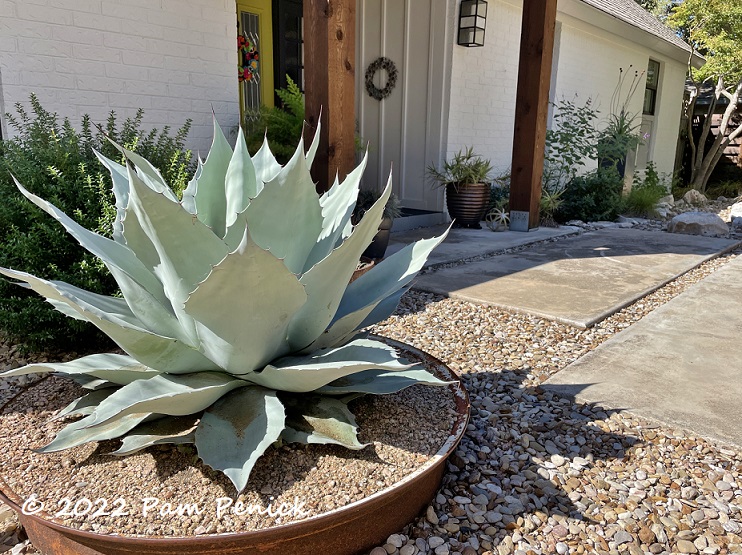
As you approach the house, a dramatic scene greets you: Agave weberi on one side of the front walk, Agave americana on the other. ‘Margaritaville’ yucca, salvias, rosemary, and feathergrass are tucked in at their feet, and shrub roses and bamboo muhly back up the agaves to completely screen half the front garden from view.


Annual poppies make a cheerful appearance here as well.


A straight-on view of the front walk shows a feathergrass gauntlet accented with California poppies. Lori constructed the front walk herself out of concrete pavers and cinderblocks.


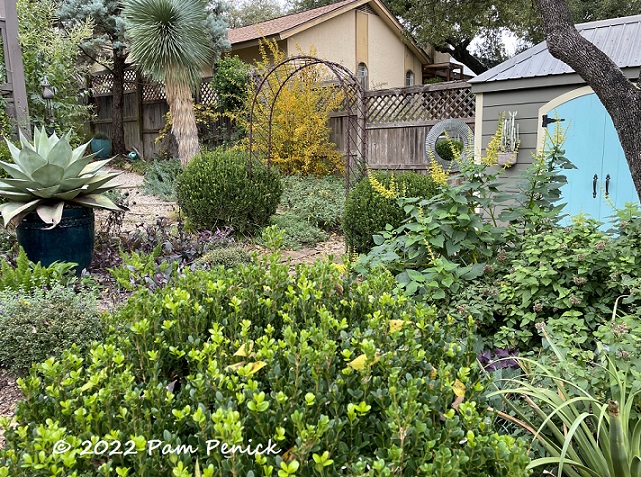
Stepping up into private front garden, you’re treated to eye-catching combos like this: ‘Powis Castle’ artemisia, smooth sotol (I think), yellow bulbine, ‘Color Guard’ yucca (in the pot), and Mexican feathergrass.


A wider view reveals the front walk (leading through the feathergrass) and a perpendicular walk that runs in front of the house and around to the side.


A hidden patio composed of a geometric arrangement of concrete pavers comes into view from the front porch.


A closer look reveals a fun accent: a half-face planter. We’ll see many more of these placed throughout Lori’s garden.


The deep, shady porch provides respite from the Death Star. Lori has accented the eaves with cut-out wooden stars inspired by the garden of Donnis Doyle.


Along the front porch, foxtail fern softens the step in a pretty pot, with a diminutive ajuga colonizing the shady gravel path. Heartleaf skullcap and flowering violas add seasonal color.


Violas


Taking the perpendicular path along the front porch, you enter the geometric patio, where you’re treated to multicolored ‘Mutabilis’ roses and a color-coordinated aeonium in the face planter.


A closer look


A narrow side path bordered by Mexican feathergrass leads to the back gate — a charming peek-a-boo gate, with metal screening creating a window and framing a garden view.


From the other side it’s just as appealing. Lori has stained her fence and gate blue, the color of her home, porch, and wooden decks. The plants really “pop” against that dusky blue.


The long, narrow side garden is greened up with a mix of fence-hugging vines and bright, variegated groundcovers, all mulched with shredded wood, with no edging to separate planting bed from path.


Walking along the path, you see another face planter ahead, with Southern wax myrtle screening the rest of the garden from view.


Lori has mixed dwarf ruellia, both purple- and white-blooming, and variegated liriope along the path — “a strategic choice,” she says, “since I don’t have lighting in that side yard. All of those whites glow at twilight so I can see where to walk. I water it only rarely, even during periods of horrible drought, and cut it all down to the ground once a year, so it’s pretty much the perfect low-maintenance planting.”


A cut-leaf philodendron marks the end of the path, and it’s underplanted with that brightly variegated liriope.


Now the back garden opens to view. Deep borders along the fence lines are packed with a mix of textural, blooming, and structural plants, many of which are native to central Texas: datura, rosemary, heartleaf skullcap, prickly pear, agaves in pots, roses, Mexican buckeye, Mexican feathergrass, and bamboo muhly, to name a few. A bit of lawn remains, and it functions primarily as a wide, curvy path through the garden and as a negative space to rest the eye.


A native mesquite tree anchors the center of the garden, its sculptural limbs supporting a feathery canopy of leaves.


One branch serves as a bottle tree, with carriage screws supporting an assortment of blue bottles.


A deep porch and a Florida room (not pictured) along the back of the house provide plenty of space to sit and view the garden. A shed (pictured), brightened with window-like mirrors, anchors one end of the porch. In the L-shaped space between shed and porch, Lori solved a persistent drainage problem by constructing a decomposed-granite patio raised one step to the level of the porch. A double line of concrete pavers leads the eye (and the feet) from the porch directly to the lawn.


I like the way Lori created a bed around the mesquite that’s mostly at ground level but also continues at patio level, with feathergrass and pink evening primrose planted directly in the decomposed granite.


Pink evening primrose


This beautiful vessel fountain is a new addition since last time I visited. Plumbing pipe pours water into a glazed, sculptural container, which spills into an arrangement of Mexican beach pebbles. The water circulates into an underground basin and back up through the pipe. Update from Lori about the basin: “The basin for the fountain is by John Lamos, an artist based in northern California. He specializes in lightweight sculpture using sustainable materials.”


Following the line of pavers, your eye is drawn to a trio of face planters arranged on a low retaining wall.


Blue-green heartleaf skullcap behind the faces will be blooming soon.


Another trio — this time golden barrel cacti in a metal planter. Ice plant trails along the edge.


Lori has a flair for displaying pots in an eye-catching way. In this collection on her patio, she sets another face planter on a mini-plinth of concrete pavers and elevates a cobalt-blue pot on a few tinted pavers. Glass beads and Mexican beach pebbles used as mulch add a finishing touch.


An enormous cardoon adds bold foliage to a small vegetable garden planted along the shed.


Looking back to the mesquite bed. Light-catching grasses are complemented by chunky Opuntia pads and sword-like agave leaves.


The fountain is pretty from every angle.


On a wall on the covered porch, Lori creatively hung a leftover section of gutter, painted it blue, and planted it up with grandfather’s pipe (Callisia fragans) cuttings. The shady space is brightened with mirrors disguised as windows.


Blue is definitely the color of choice in Lori’s garden, including in this charming vignette along a corner of the foundation. Yellow in the golden barrel cactus, yucca, and agave makes a perfect complement.


At the gate on the other side of the house, a variegated agave and purple heart in a silver container, set on a homemade plinth of concrete pavers, make an eye-catching focal point. A round mirror reflects light like a silver moon.


Along the back of the house, a line of ‘Color Guard’ yucca is surrounded by colorful, blooming ice plant, orange narrowleaf zinnia, and blackfoot daisy. Like all of Lori’s garden, it’s a charming and creative combination with an element of surprise.

Lori, thanks so much for letting me come back to photograph your garden as it continues to evolve! Readers, if you’d like to read my previous post about the Garden of Good and Evil, click here.

You’re Invited!
I’ll be at
BookPeople on Saturday, May 4, at 4 pm , along with author Jenny Peterson, to talk briefly about design tips for losing the lawn or paring it back. Jenny will be sharing styling tips for houseplants. And we newbie authors will BOTH be signing copies of our books! Whether you have a green thumb or a brown one, let’s fill up BookPeople with people who care about plants and the earth!

The talk is free and open to the public, and I’d love to see a lot of friendly faces! If you do want an autographed book, BookPeople requires an in-store purchase. Just FYI.

All material © 2006-2013 by Pam Penick for Digging. Unauthorized reproduction prohibited.

Bonny bluebonnets and more at the Wildflower Center, part 2


I promised you Texas bluebonnets (Lupinus texensis) in my previous post, part 1 of last Friday’s visit to the Wildflower Center, and bluebonnets you shall have, with a bonus of winecups (Callirhoe involucrata)!


This little boy was certainly enjoying the bluebonnet meadow, running his hands along the tops of the flowers. I understand that urge—I like to feel the texture of plants too, and while bluebonnets are too low for me, they are just the right height for him.


A wider view of the bluebonnet meadow reveals a solitary Indian paintbrush as well, plus a pink penstemon.


A closer look at the penstemon


How about some columbines? Yes, please!


Ducking into the shade of the Hill Country stream garden, I enjoyed a backlit view of the meadow.


Yucca and bluebonnets


The steel siding on the administrative building and cistern seems to echo the blue of the bluebonnets.


A shady spot to take a rest


Moving on, I admired this yellow wildflower against the spiky, blue leaves of a yucca.


The sun-washed demonstration garden includes a favorite feature of mine, a stock-tank pond.


Fiery Salvia coccinea was blazing with color in the bright sunshine.


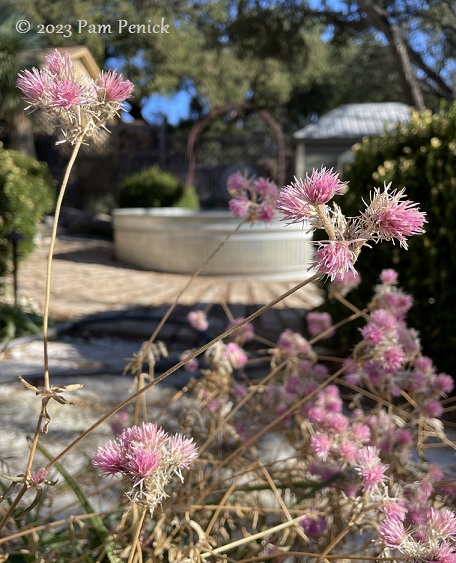
A wider view, with pink evening primrose tumbling over the edge of an enormous stock-tank planter in the background


Poppies! (using my best Wicked Witch of the West voice)


I had no idea that California poppies (Eschscholzia californica) are native to Texas, but apparently so. The Wildflower Center only grows plants native to Texas. Correction: These are Mexican gold poppies (Eschscholzia californica ssp. mexicana), a subspecies of the California poppy that is native to west Texas. Thanks to Peter Schaar for the ID.


Claret cup cactus (Echinocereus triglochidiatus) in bloom. What stunning, orange flowers perched atop that rhinocerous-skinned plant!


A number of kinetic sculptures are currently on display in the gardens, and on this windy day they were spinning merrily. (Most of my photos, if you’re wondering, were shot during moments of stillness to avoid tell-tale blurriness.)


A look back across the open demonstration garden reveals that yellow is a dominant color for native Texas plants in springtime.

Stay tuned for a third and final post about my visit to the Wildflower Center, featuring another charming wildflower: Indian blanket. For a look back at part 1 of my recent Wildflower Center visit, click here.

All material © 2006-2013 by Pam Penick for Digging. Unauthorized reproduction prohibited.

How to spring clean your stock tank container pond


A few years ago I wrote a post explaining how to make a container pond in a stock tank, and many readers have since written to tell me they’ve made their own ponds by following my instructions. I also get a lot of questions about how to take care of a stock-tank pond throughout the year, so last fall I wrote a follow-up post about winterizing my pond, and today I’ll show you how to clean a stock-tank pond in preparation for summer. Keep in mind that all my pond information is relevant for zone 8b; those of you in colder climates should consult a local pond expert for more information.

The picture above shows just how ugly my stock-tank pond looked last weekend, after a few winter freezes and the big leaf drop that happens in mid-March as the live oaks shed their old leaves. Not pretty! With freezing temps behind us and summer right around the corner, it was time to clean the pond.


First I put on old clothes that I didn’t mind getting muddy. Next I unplugged the pump that runs the spigot fountain. Then I reached in and pulled out all the plants. Have I mentioned that pond plants grow like they’re on steroids? This is my ‘Colorado’ water lily after a season of growth. It’s grown right out of its plastic container and produced an entirely new plant, connected to the old one, outside the pot. Look carefully on the lower right, and you’ll see the rim of the black plastic pot. The mass in my hands is the new, unrooted lily.


Once all the pond plants are out of the pond (place them under wet newspapers in the shade if the day is hot; they should not be allowed to dry out), use a sturdy net to clean the surface of the pond of leaves, rotted plant material, and other debris. Then sweep the bottom of the pond with the net, lifting out decomposing plant matter and putting it in the compost pile. Be careful not to scoop up or accidentally discard your fish. Once you start netting the bottom of the pond, the water will get cloudy with silt, so you’ll need to examine your net carefully each time you dump it out. Alternatively, you could net your fish and put them in a clean tank filled with pond water while you clean, but I never do this and still end up with what seems like all my fish.


Once the pond is mucked out, it’s time to divide the plants. Pond plants need dividing every year because of their aggressive growth. The nice thing about this is that you can furnish your pond-loving friends with divisions each year. Of course, next year they’ll be looking for someone to give their divisions to as well.

If you can slip or shake your plant loose from the plastic pot, great. Sometimes, however, the plant just won’t budge. In that case, I use a hatchet to split the side of the pot, cutting the plant loose and exposing a very root-bound plant.


Then I use the hatchet to cut through the root-bound plant, dividing it in half. You could also use a plant saw to divide the plant, and maybe that would be safer than a hatchet. I am quite careful about where I swing that blade.


The hatchet goes through all that mess as if it were soft butter.


Here I’m dividing a slightly less messy ‘Helvola’ water lily. Make sure you divide so that you see stems and roots in each piece.


Chop, chop. I got three divisions out of this one.


Place your divisions, ideally, in solid, plastic pond pots with no drainage holes. However, if, like me, you neglected to buy enough pond pots, you can use regular nursery pots. The plant will probably send roots out through the drainage holes, but since the pot sits in a metal tank, the plant can’t really escape anywhere.

You’ll need to fill in around the divisions with soil. Pond plants like to be planted in heavy clay. Don’t use regular bagged potting soil, which is too light and will float out of the pot. I just go out in the garden and dig up some clayey soil, of which I have plenty, to fill in my pots. If you don’t have clay soil in your yard, heavy potting soil can be purchased at pond stores. Hill Country Water Gardens in Cedar Park, for example, sells a 50-lb. bag for $5. I’m sure you don’t douse your lawn or garden with chemical fertilizers or pesticides, but if so, you shouldn’t use that soil in your pond.


Here’s a ‘Helvola’ division all potted up with lots of growing room. Next step: top your plant pots with a layer of clean gravel to help keep fish from nibbling the plant down to nothing and to keep mud from clouding your water. I press one fertilizer tab for pond plants into each of my new divisions and then place them back in the pond. Water lilies go on the bottom of the tank; marginal or bog plants go on top of overturned pots or piles of bricks so that they sit near the surface.


The final step is to purchase new underwater cleaner plants, which are essential for keeping your pond free of algae in the summer. I use 8 bundles of anacharis in my 700-gallon pond. Place the bundled anacharis stems in pots of clean gravel (no need for soil) on the bottom of the pond. The gravel holds the bundles in place.


Take this opportunity to clean out the filter in your pond pump. Remind yourself that you really should stay more on top of cleaning your pump’s filter. Then put it back in the pond and plug it in.


Voila! Your pond is clean and ready for summer. Enjoy!

This is part 3 of a 3-part pond series:
Part 1 — How to make a container pond in a stock tank
Part 2 — Winterizing a stock tank pond
Part 3 — How to spring clean your stock tank container pond

All material © 2006-2013 by Pam Penick for Digging. Unauthorized reproduction prohibited.