
Gardens on Tour 2013: Kathy Cove Garden


Garden tour season in central Texas kicked off last Saturday with the annual Wildflower Center-sponsored Gardens on Tour, which this year featured five Austin gardens in which native plants play a predominant role. I toured with three other bloggers — Cat from The Whimsical Gardener, Shirley from San Antonio’s Rock-Oak-Deer, and David from Albuquerque’s The Desert Edge — and if you check out their blogs you may get additional perspectives on the gardens I’ll be posting about this week.

We began the tour with the Kathy Cove Garden, a remodeled property in south Austin’s Barton Hills neighborhood. Perched on the edge of a canyon overlooking the Barton Creek greenbelt, the home and garden enjoy spectacular views of both the greenbelt and downtown Austin. The front garden, as you see, is still a work-in-progress, with rock work by Environmental Survey Consulting in place and just a few plants situated.


A vibrant clump of standing cypress (Ipomopsis rubra) captured attention out front.


Moving around to the back garden, you pass this monumental sculpture, which looked vaguely Mayan to me.


Picking your way down a rugged limestone stair, you pass a teak hot tub nestled alongside limestone boulders and the entrance to a mid-level deck that stretches along the back of the house. Continuing to the bottom of the stone steps leads you to…


…a beautiful swimming pool surrounded by a pieced-limestone pool deck. Check out that view of the greenbelt.


You’d never know this home is 10 minutes from Zilker Park and downtown Austin.


The tightly fitted rock work is a trademark look by Environmental Survey Consulting that we saw echoed in two other gardens on this tour.


Under the deck, a surprising water feature — a stacked-limestone wall trickling with water (refreshed by A/C condensate) and colonized by maidenhair fern — adds visual cooling and creates a green view in place of the usual shadowy under-deck eyesore.


It reminded me of the natural cliffside waterfalls that can be found along Austin’s greenbelts.


A wider view shows the under-deck water-wall at left, with the cobalt pool extending the length of the terrace.


The garden is very naturalistic overall, in keeping with the rugged hillside setting. Red yucca and salvia were in bloom, attracting hummingbirds that zipped around us.


The homeowner has a large sculpture collection, which includes this bird (a raven?) perched atop a boulder, a glass orb in its beak.


Religious sculpture also finds a home here. I can’t help wondering — is the cactus collection at Christ’s feet a reference to his crown of thorns?


A Lady of Guadalupe with a spark-plug aura illustrates a similarly playful/ironic take on this traditional Catholic icon.


A pieced-stone path leads along the back of the house, hugging the top of the canyon. Amid the naturalistic plantings, a series of turquoise pots — each a miniature container pond — adds necessary rhythm to the scene.


A charming pond in miniature


Rugged paths lead down into the canyon, but I didn’t follow them. Instead I climbed up to the deck, past naturalistic garden beds. Red-blooming Texas betony spilled over limestone terracing.


Pausing to look back down the stone steps, I enjoyed a view of downtown Austin and a cardinal that shot across my field of view at just that moment.


The deck wraps the back of the house and provides several intimate seating areas to enjoy the treetop view.


I admired this simple trough with multi-colored succulents. The succulents are still in their nursery pots, rather than planted into the trough, making for a quick and attractive display.


More succulent troughs create a linear centerpiece on a dining table nearby.


They almost look good enough to eat!


Looking down at the path traversing the back of the house, you can see that the garden is still very new. Many of the plants have not had time to fill in yet.


When they do, this will be an even more spectacular space.

Next up: The contemporary Westridge Drive Garden, with a unique rebar awning and yucca and manfreda in full bloom.

All material © 2006-2013 by Pam Penick for Digging. Unauthorized reproduction prohibited.

Blossoming spring morning at the Wildflower Center, part 1


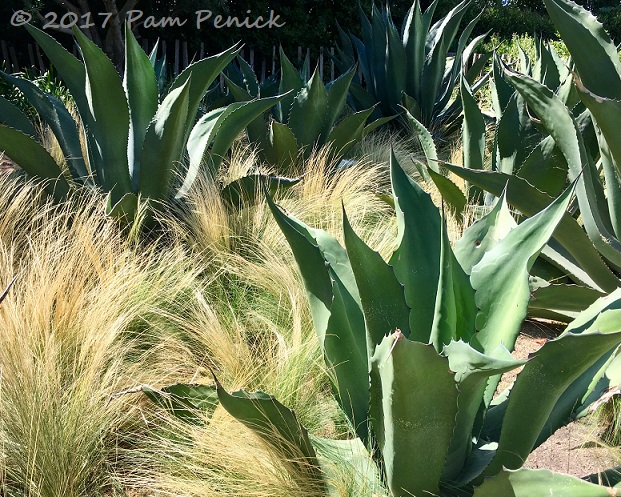
April is high season for wildflowers in Texas, and if you can’t get out for a country drive to admire them in meadows and fields, an Austinite can always get a fix at the Lady Bird Johnson Wildflower Center. I stopped by for a wildflower stroll on Friday morning. Before I’d even pulled into the parking lot I stopped to ogle this spiky/soft combo of agave (maybe A. neomexicana?), Gulf Coast penstemon (Penstemon tenuis), and pink evening primrose (Oenothera speciosa).


Muscular agave leaves…


…make a strong backdrop to the tissuey, pink petals of the primrose.


A closer look


Even closer. Notice the pollen dust held by the veined, cupped flower.


Entering the gardens you pass a grassy meadow studded with yuccas (perhaps Y. pallida), their bloom stalks held aloft like flagpoles. Soon they’ll all be flying white flags.


The striking architecture of the Wildflower Center, with its copper-colored stone and heavy arches softened by trailing vines, is an important part of the garden.


Tucked high up in an alcove planter, nesting under a Wheeler sotol, is a great horned owl. She has two nearly full-grown chicks that I’d hoped to see. But a brisk wind seemed not to their liking. The chicks tucked themselves in too low for photos, and Mama Owl turned her face to the wall, staring at it placidly as the wind gusted around her.


Just to her left is the pretty little entry pond.


I didn’t get the ID of this flowering pond plant. Update: Hymenocallis liriosme


A clear blue pond, built to resemble a spring-fed pool in the Hill Country called Jacob’s Well, or so I’ve heard, anchors the main courtyard.


Seating at one side of the courtyard makes a pleasant spot to enjoy lunch from the cafe.


More of that marvelous architecture. This is the Wildflower Center’s signature tower. The core houses a rainwater-collection cistern, and you can walk a spiraling stair up to the very top for an overlook of the grounds.


Continuing along the back of the tower instead, I snapped a photo of another of the massive cisterns that dot the grounds, a reminder of how vital water collection is in central Texas. I love this style of cistern—all that galvanized metal and the cylindrical silo shape—and wish I had one in my own garden.


Espaliered on a section of cattle-panel fencing, a Mexican redbud (Cercis canadensis var. mexicana) sapling’s glossy leaves show to advantage.


Another smaller cistern in the children’s garden makes a rustic backdrop to a blooming Texas wisteria vine (Wisteria frutescens).


I sat here for a few minutes to soak in the beauty of the morning—a cool, sunny morning of the sort we’ll be longing for soon enough—and the wildflowers blooming all around me…


…like this swath of pink evening primrose.


But what about Texas bluebonnets, you may be wondering? Oh yes, they were blooming too. Stay tuned—I’ll have pictures of bluebonnets in part two of my Wildflower Center visit.

All material © 2006-2013 by Pam Penick for Digging. Unauthorized reproduction prohibited.

How to spring clean your stock tank container pond


A few years ago I wrote a post explaining how to make a container pond in a stock tank, and many readers have since written to tell me they’ve made their own ponds by following my instructions. I also get a lot of questions about how to take care of a stock-tank pond throughout the year, so last fall I wrote a follow-up post about winterizing my pond, and today I’ll show you how to clean a stock-tank pond in preparation for summer. Keep in mind that all my pond information is relevant for zone 8b; those of you in colder climates should consult a local pond expert for more information.

The picture above shows just how ugly my stock-tank pond looked last weekend, after a few winter freezes and the big leaf drop that happens in mid-March as the live oaks shed their old leaves. Not pretty! With freezing temps behind us and summer right around the corner, it was time to clean the pond.


First I put on old clothes that I didn’t mind getting muddy. Next I unplugged the pump that runs the spigot fountain. Then I reached in and pulled out all the plants. Have I mentioned that pond plants grow like they’re on steroids? This is my ‘Colorado’ water lily after a season of growth. It’s grown right out of its plastic container and produced an entirely new plant, connected to the old one, outside the pot. Look carefully on the lower right, and you’ll see the rim of the black plastic pot. The mass in my hands is the new, unrooted lily.


Once all the pond plants are out of the pond (place them under wet newspapers in the shade if the day is hot; they should not be allowed to dry out), use a sturdy net to clean the surface of the pond of leaves, rotted plant material, and other debris. Then sweep the bottom of the pond with the net, lifting out decomposing plant matter and putting it in the compost pile. Be careful not to scoop up or accidentally discard your fish. Once you start netting the bottom of the pond, the water will get cloudy with silt, so you’ll need to examine your net carefully each time you dump it out. Alternatively, you could net your fish and put them in a clean tank filled with pond water while you clean, but I never do this and still end up with what seems like all my fish.


Once the pond is mucked out, it’s time to divide the plants. Pond plants need dividing every year because of their aggressive growth. The nice thing about this is that you can furnish your pond-loving friends with divisions each year. Of course, next year they’ll be looking for someone to give their divisions to as well.

If you can slip or shake your plant loose from the plastic pot, great. Sometimes, however, the plant just won’t budge. In that case, I use a hatchet to split the side of the pot, cutting the plant loose and exposing a very root-bound plant.


Then I use the hatchet to cut through the root-bound plant, dividing it in half. You could also use a plant saw to divide the plant, and maybe that would be safer than a hatchet. I am quite careful about where I swing that blade.


The hatchet goes through all that mess as if it were soft butter.


Here I’m dividing a slightly less messy ‘Helvola’ water lily. Make sure you divide so that you see stems and roots in each piece.


Chop, chop. I got three divisions out of this one.


Place your divisions, ideally, in solid, plastic pond pots with no drainage holes. However, if, like me, you neglected to buy enough pond pots, you can use regular nursery pots. The plant will probably send roots out through the drainage holes, but since the pot sits in a metal tank, the plant can’t really escape anywhere.

You’ll need to fill in around the divisions with soil. Pond plants like to be planted in heavy clay. Don’t use regular bagged potting soil, which is too light and will float out of the pot. I just go out in the garden and dig up some clayey soil, of which I have plenty, to fill in my pots. If you don’t have clay soil in your yard, heavy potting soil can be purchased at pond stores. Hill Country Water Gardens in Cedar Park, for example, sells a 50-lb. bag for $5. I’m sure you don’t douse your lawn or garden with chemical fertilizers or pesticides, but if so, you shouldn’t use that soil in your pond.


Here’s a ‘Helvola’ division all potted up with lots of growing room. Next step: top your plant pots with a layer of clean gravel to help keep fish from nibbling the plant down to nothing and to keep mud from clouding your water. I press one fertilizer tab for pond plants into each of my new divisions and then place them back in the pond. Water lilies go on the bottom of the tank; marginal or bog plants go on top of overturned pots or piles of bricks so that they sit near the surface.


The final step is to purchase new underwater cleaner plants, which are essential for keeping your pond free of algae in the summer. I use 8 bundles of anacharis in my 700-gallon pond. Place the bundled anacharis stems in pots of clean gravel (no need for soil) on the bottom of the pond. The gravel holds the bundles in place.


Take this opportunity to clean out the filter in your pond pump. Remind yourself that you really should stay more on top of cleaning your pump’s filter. Then put it back in the pond and plug it in.


Voila! Your pond is clean and ready for summer. Enjoy!

This is part 3 of a 3-part pond series:
Part 1 — How to make a container pond in a stock tank
Part 2 — Winterizing a stock tank pond
Part 3 — How to spring clean your stock tank container pond

All material © 2006-2013 by Pam Penick for Digging. Unauthorized reproduction prohibited.