
My article about John Fairey’s Peckerwood Garden wins award


Last year I wrote an article for Garden Design magazine about Texas plantsman John Fairey and Peckerwood Garden, his decades-in-the-making collector’s garden in Hempstead. “The Plant Man” appeared in the June 2012 issue of Garden Design (now, sadly, out of business).

I’m surprised and happy to tell you that my article has won a 2013 Silver Award of Achievement, in the Writing–Magazine Article category, from Garden Writers Association’s Garden Media Awards Program.


I’m grateful to the awards committee for the honor. And I’m especially indebted to John Fairey, who graciously opened his home and garden to me and shared his story over the course of a couple of interviews. Anyone who thinks gardening a dull hobby has never heard Mr. Fairey talk about his plant-hunting expeditions in Mexico, nor seen his charismatic dry garden, verdant shrub garden, or arboretum of Mexican oaks. Peckerwood is open to the public for guided tours on specific dates throughout the year. If you’ve never been, do make plans to visit this tucked-away gem of a garden.

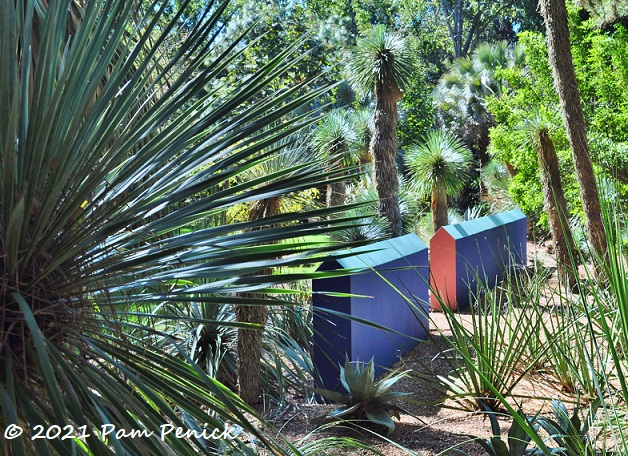
I’m republishing my article here in hopes of introducing you to two Texas treasures: Mr. Fairey and his garden. The images in this post are from a visit to Peckerwood in 2008. I’m long overdue for another photo-taking tour myself.

The Plant Man

A flora collector with a rare eye for design transforms a Texas landscape

John G. Fairey’s eyes widen when he is asked to name a favorite plant, as if he’s been asked to choose his favorite child. “Why, all of them,” he replies softly in a sandpapery Southern lilt. And given his surroundings — some 3,000 species of rare and endangered plants at Peckerwood, his 40-year-old, renowned private garden near the Texas town of Hempstead — you’re rather inclined to believe him.

Named for the Georgia plantation in Auntie Mame, Peckerwood has earned plaudits for its astonishing collection of plants — largely from Mexico and Texas but also Asia — and for the horticultural skill with which Fairey grows them. It also deserves attention for the artistic design of its landscape — unusual for the garden of a collector, in which acquisition often supersedes design considerations.

Fairey’s vision for Peckerwood, which includes a light-dappled woodland, several shimmering dry gardens, and a parklike arboretum, developed not gradually but in a transformative awakening during a trip to Mexico. An artist and professor of design at Texas A&M, Fairey had bought seven acres near Hempstead, an hour’s drive northwest of Houston, in 1971 as a country retreat. He planted azaleas, camellia, and other species familiar to him from his South Carolina childhood, but his interest in collecting plants wasn’t sparked until he met Texas plantsman Lynn Lowrey, who often trekked into Mexico to search out little-known species to bring back for propagation.

In the summer of 1988, Fairey joined Lowrey on one of his expeditions to the Sierra Madre Oriental mountain range in northeastern Mexico. They explored from desert to cloud forest, says Fairey, and searched for plants from dawn until after dark, by flashlight. The adrenaline high of the hunt hooked Fairey immediately, as did the evidence of the loss of fragile habitat caused by the overgrazing of goats and the sense that he could help save plants from extinction.

Over the years, Fairey returned to the Sierra Madre 100 times, fascinated by the variety and architectural beauty of the plants he found there. Back home he began using a newfound palette of sun-loving plants like yucca, agave, dasylirion, nolina, and dioon in his dry gardens and designing with shape and form, wind and sunlight, rejecting in one swoop both the English tradition of soft, flowering borders and the European model of formal framing and symmetry.

Today, plants reign supreme at Peckerwood, providing structure for garden rooms with their architectural forms and through massing of related species — “counterparts,” he calls them — from different parts of the world, like his screen of mahonia from both Asia and Mexico in the woodland garden. And as John Troy, a San Antonio landscape architect, points out, Fairey also plays up a feeling of surprise and dissonance by mingling species not normally seen together on this side of the border, like palms and magnolias, pines and agaves.

One encounters these arresting combinations throughout Peckerwood but especially in the sunny, dry garden on the west side of Fairey’s residence, a two-story, corrugated steel-sided structure with a shady porch and attached art gallery. In the dry garden, fine, rounded gravel surrounds the plants and flows between them, forming paths and creating a natural-looking “floor,” knitting the garden together with a consistent color and texture. To the northwest of the house, in the woodland garden, pine straw supplants gravel, mulching plants and quieting visitors’ footsteps. Throughout, paving, walls, and other hardscaping are kept to a bare minimum, enhancing the naturalistic look.

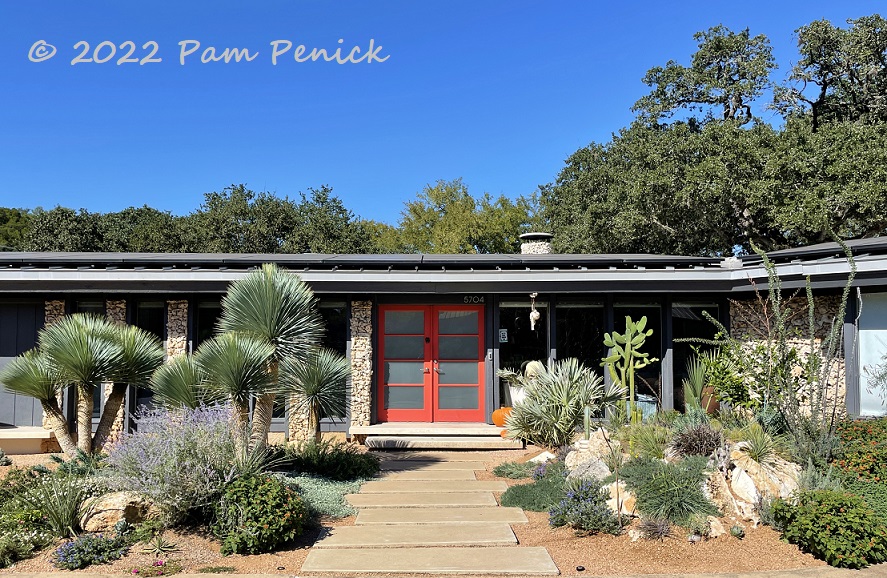
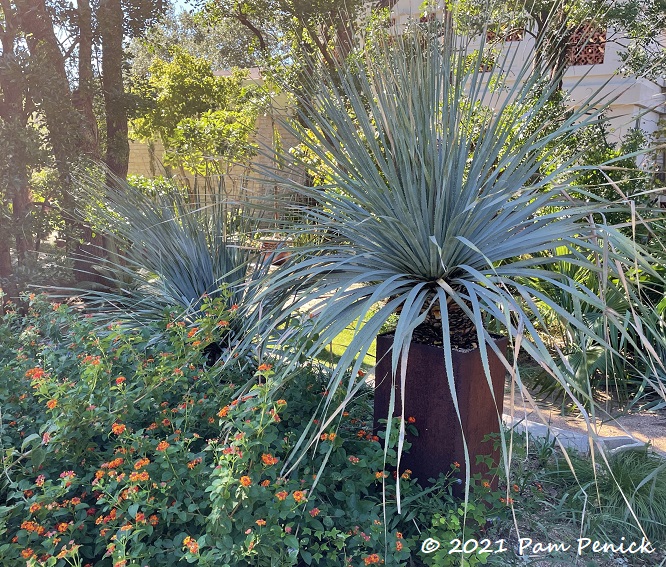
Fairey enjoys the act of planting and likes to experiment, digging things up and trying new combinations with such regularity that a friend once remarked he’d “never seen a plant at Peckerwood that wasn’t on the end of a shovel.” When siting plants, Fairey considers the play of light on leaves and the ever-present Texas wind, especially in the dry garden. During the blazing summer, that space is psychologically cooling thanks to an abundance of silver and blue-green leaves, like those of Yucca rostrata, a strappy Koosh ball of a plant that responds to every cooling breeze with a dazzling shimmer. Round forms and modernist geometry dominate here; spherical plant types like Echinocactus grusonii, Dasylirion longissimum, Nolina nelsonii, and Xanthorrhoea quadrangulata create a bouncy rhythm. Compensating for gully-washer summer thunderstorms and winter rains, Fairey elevates each plant for drainage on its own gravel hillock, “because I like mountains,” he laughs, a reference to his passion for exploring Mexico’s northeastern range. But Austin landscape architect James David sees the artist’s eye at work. “Individual plants are put on gravel pedestals for you to admire,” he says, “like buckets of hyacinths on display in a flower shop.”

“Every bit of the garden is thought through from a design standpoint,” says Bill Noble, director of preservation at the Cold Springs, New York-based Garden Conservancy. “If you know plants, then John’s collection will blow you away. If you don’t know the plants, you can still appreciate their beauty and the design of the garden.”

Because Peckerwood is such a unique repository and because Fairey is looking to the garden’s future, the Garden Conservancy is assisting him in transitioning it to a public entity. Asked what he would like for gardeners to take away from a visit to Peckerwood, which today encompasses 39 acres, Fairey says simply, “diversity.”

“John has expanded the palette of plants for gardeners in the South, Southeast, and Texas,” says Noble. “His garden has a lot to teach.” After a lifetime of teaching, Fairey remains himself an eager learner, continually experimenting with plants and treating his garden as an artist’s canvas on which he paints with light, foliage, and even the wind.

All material © 2006-2013 by Pam Penick for Digging. Unauthorized reproduction prohibited.

Read This: Yards and Fine Foliage


Two new books from St. Lynn’s Press are well worth some of the precious real estate on your bedside table as you start making plans for your garden this spring. I’ve followed Santa Barbara, California, landscape architect, garden writer, and funny guy Billy Goodnick online for several years. His debut book is called Yards: Turn Any Outdoor Space Into the Garden of Your Dreams. It’s an excellent primer about how to design your own garden in the same way that a professional would. While this might be dry reading in the hands of another writer, Goodnick’s trademark humor and wry, down-home colloquialisms lighten the mood and keep you engaged as you work through his design exercises.


Sketch by Billy Goodnick, from Yards

Work? Yes, as Goodnick says straight up in the introduction, “A good yard doesn’t just happen. You’ve got to work for it….The work I’m talking about starts between your ears.” His exercises show that it can take a lot of thinking to really get to know your yard and yourself—and to narrow the options for your design. Under his laid-back, joking persona, he’s surprisingly methodical, leading you step-by-step through the thought processes and creative exercises that yield a design that’s not only beautiful but well suited to the way you live.


Photo by Holly Lepere, from Yards

For readers who don’t want to do the exercises (you know who you are!) but prefer to just glean inspiration from pretty pictures, Yards offers that too (see this image and the one below). However, most of the images are tighter views of design or planting details. The real meat of the book is truly in working through the design process that Goodnick lays out.


Photo by Billy Goodnick, from Yards

His design advice is spot-on and will get you from that nebulous, anxious feeling of “where do I start?” to a plan of action with regard to your yard. If you’re a do-it-yourselfer, Yards will help you figure out what you want to do and get going on it. If you’re more inclined to hire a designer, Yards will help you settle on specific ideas that you can then share with your designer.


If you’re tired of the same old flower-based combos in your garden, or bored with seasonal containers planted up with pansies, petunias, or whatever flowering annual is on sale at the big-box store this week, read Fine Foliage: Elegant Plant Combinations for Garden and Container by Seattle authors Karen Chapman and Christina Salwitz. They know that foliage-based gardens offer longer seasons of interest, contribute to winter structure if evergreen, and generally require less work than traditional flower gardens. While we may await ephemeral flowers with anticipation, it’s foliage that carries a garden through the seasons and the years.


Photo by Ashley DeLatour, from Fine Foliage

Chapman and Salwitz take the guesswork out of combining foliage plants by providing more than 60 “recipes” and explanations for why their combos work. I like that each arrangement is given a two-page spread, with a full-page photo of the combination and smaller images of the individual “players,” along with growing information. Most helpful is a paragraph about why each combination works—how the plants harmonize, for example, or provide pleasing contrast. These design observations are great teaching tools, allowing you to become more adept at making your own combinations.


Photo by Ashley DeLatour, from Fine Foliage

As with most gardening books not focused on central Texas’ unique climate, most of the plants named here won’t be relevant for our gardens. Don’t let that dissuade you from studying these combinations anyway. Because the authors explain why the combos work, all you need do to copy them is substitute plants that do grow well here for any unsuitable ones.

For instance, to replicate the “Purple Waves” combination shown above—made up of purple fountain grass (which grows well as an annual in central Texas), ‘Rose Glow’ barberry, and ‘Silver Mound’ wormwood—simply sub out the barberry for loropetalum and the ‘Silver Mound’ wormwood for unbeatable ‘Powis Castle’ artemisia, and you get the same look, but with plants that are known to grow well here.

This spring, follow the plant recipes in Fine Foliage to cook up some great new combos for your garden.

Disclosure: Billy Goodnick sent me a copy of Yards, and St. Lynn’s sent me a copy of Fine Foliage for review. I read and reviewed each book at my own discretion and without any compensation. This post, as with everything at Digging, is my own personal opinion.

All material © 2006-2013 by Pam Penick for Digging. Unauthorized reproduction prohibited.

posted in Books, Design

Drive-by Gardens: Bouldin neighborhood in South Austin

Driving through near-downtown Bouldin neighborhood last weekend, I was struck by the number of lawnless front yards in one short stretch of W. Live Oak Street. Luckily I had my camera, so I decided a drive-by post was in order—but truth be told, I got out of the car and walked up and down a block of Live Oak to better view several of these gardens.

Traditional Bungalow with Gravel Garden


This traditional bungalow with a spare gravel garden in lieu of lawn is the first one that caught my eye. The Texas Black gravel is a hip choice for contemporary Austin gardens, as are the “floating” concrete pavers. It’s all a little spare for my taste, but I appreciate the softening influence of the Mexican feathergrass on the left and the Knock Out roses on the right. I bet their water bill is low! Look carefully to the left of the roses and you’ll see an old-fashioned reel mower—an ironic yard-art display?

Texas-Style Cottage


Across the street, this yellow cottage says howdy with a bermed, xeric garden outside a rustic plank fence. Agave, bamboo muhly, coral honeysuckle, and various groundcovers combine pleasantly, framed by a low, ranch-style wooden fence and simple, flat-top arbor. The bermed plants and fence provide a sense of privacy for a small lawn and the house.

Contemporary with Feathergrass


Back across the street, next door to the first house I showed you, is this contemporary home with a touseled garden of Mexican feathergrass, shrub daisies, and shoestring acacias. It’s a little messy, definitely shaggy—and I quite like it. The aqua metal planters topped with yellow-flowering bulbine are a funky and fun touch. The one inside the fence is elevated on a chunky, rusty metal post.


Outside the fence, a second planter sits on the ground.

Contemporary with Red Lines & Metal Fence


OK, this one still has a lot of lawn, but the house and fence caught my eye, as did the stoplight-red Knock Out roses. A lot more could be done with this one to complement the style of the house, don’t you think?


I do like their contemporary mailbox.

Contemporary with Desert Garden


This one may be my favorite based on the garden alone. But wow, look at the house too—kind of like a Mondrian painting. I found a lot of info about this home online. Check out the tour of the interior and owner interview on Apartment Therapy. I also learned that Big Red Sun designed the landscaping.


Are any desert gardeners (or Big Red Sun employees) reading this? What kind of cactus are the tall, columnar ones? I’ve never seen any that big growing in Austin. Update: Two readers have ID’d it as Argentine saguaro (Trichocereus terscheckii). The soap aloes were in full bloom already (my own are just starting to bloom) and eye-catching.


Their coral-red blossoms really stand out against the dark siding on the house.


Another view, with golden barrel cactus in the foreground.


Another view shows drought-tolerant bulbine and bamboo muhly as well.


A few agaves, sedum, desert willows, and Lindheimer nolina round out the xeric scene.


Notice how they slightly bermed this garden and mulched with gravel for sharp drainage. These plants will rot in soggy soil.


A lusher aesthetic takes hold behind a low wall with the house number carved into it (love!). A Texas mountain laurel on the right is underplanted with some type of sedge—maybe Texas sedge? The Japanese maple in gravel (at left) in our hot climate makes me cringe a little; they love cool, moist shade, after all. But I do like the sedge “lawn” that doesn’t need mowing. I have reservations about the zig-zagging boardwalk front path. It feels a little too beachy and too haphazard for the clean lines of the house. Wouldn’t a floating concrete-paver walk or Corten-edged path have been a better choice? Still, what an interesting low-water garden!

Contemporary with Bamboo Muhly Grass


Just a few blocks away on West Mary Street, I slammed on the brakes when I spotted this contemporary home floating in a cloud of chartreuse bamboo muhly grass and airy, xeric trees. With a few clumps of Texas bluebonnets, roses, and steel-blue agaves to set it off, this mass planting is really effective.


A closer look at this water-thrifty streetside planting.


A side entrance reveals a citron-yellow door, playing off the chartreuse bamboo muhly, and an irregular, floating-concrete walk. Agave, nolina, and rosemary add evergreen foliage on the right, and huge oaks lean over a graveled court (for parking?).


Some patchy lawn remains in back, but this fuchsia penstemon (I think) is what caught my eye. Cool garden!

Bouldin Castle


If you don’t care for contemporary boxy houses and straight lines, maybe a rugged stone castle is more your style? I’d never come across Bouldin Castle before, located at 715 W. Mary St., but it’s apparently quite well known, as I discovered when I looked it up online. Originally constructed in 1925 as a church, the “castle” has been preserved over the years, most recently as a rental vacation house.


A fortress-like wall hides most of the garden from view. Outside the wall, a spiky “moat” of agaves mulched with decomposed granite, accented with a few xeric trees (Texas persimmon? Texas mountain laurel?), keeps things simple.


How I’d love to step through that gate and see the rest of the garden and inside the house. Luckily, photos of the fascinating interior and the courtyard garden and lap pool are available online.


It looks like an eclectic mix behind that wall.

I hope you enjoyed this mini-tour of a few interesting streets in Bouldin neighborhood. All I could think, as I drove and walked around, was how cool it would be to live in such a diverse neighborhood, with so much to see every time you step out the door.

All material © 2006-2013 by Pam Penick for Digging. Unauthorized reproduction prohibited.