
Gardens on Tour 2013: Highland Terrace West Garden


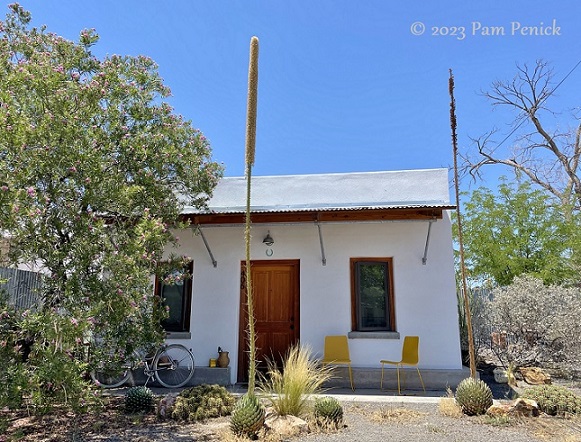
I used to walk by this house every day while picking up my son from kindergarten, and each time I’d gape at the lush, shade garden fronting the charming cottage with the welcoming front porch, wondering what the rest of the place looked like. Twelve years later, I finally found out. The Highland Terrace West garden, located in north-central Austin’s Highland Park neighborhood, was the fourth we visited on the Wildflower Center-sponsored Gardens on Tour last Saturday. Let’s take a tour together, shall we?


The deep front porch has always called to me. It’s so inviting, and I love the cozy, red-and-brown color scheme.


One of the porch columns has been partially removed (I assume it wasn’t weight-bearing), and the remaining section now serves as a plant pedestal. For a red pot, of course, with coleus to match, sweet potato vines providing chartreuse and eggplant accents, and a reddish grass adding height.


At its base, a homemade concrete dish holds a tiny cactus and succulent collection.


The garden is packed with charming details, with interesting vignettes around every turn. But I knew the owners were fearless when I spotted this window box packed with succulents and my touring buddy Cat leaned in to touch the leaves of the large, purple echeverias. “They’re not real,” she said. They sure do pass though. I decided on the spot that someone with the chutzpah to pull off a mix-up of real and fake plants was going to be defying expectations in other ways, and I hoisted my camera to be ready.


One thing this garden excels at is using commonplace plants in particularly beautiful ways. Here, softleaf yucca, purple heart, and ‘Katie’ dwarf ruellia combine long, pointy leaf shapes in various hues, making a pretty setting for a piece of garden sculpture. Silver ponyfoot froths at its feet.


As you walk around the right side of the house, you see another fabulous combination in silvery pale-green, anchored by a silver Mediterranean fan palm (I think). Groundcovers flow around a large boulder set in the bed, and on the fence a frilly metal ornament provides a color echo of the plants.


I covet this combo. And to think I used not to care much for palms. Scenes like this have converted me.


Side yards are often repositories for trash bins and workbenches, and the owners have beautified even these necessaries. The trash bins and wheelbarrow are tucked behind a handsome, gated extension of the board fence.


A wider view reveals the gated bin corral on the right and a winding path that ducks around a tree as it leads to the rear garden. Two structures ahead obscure a longer view and entice you forward.


But eye-catching details along the path also grab your attention, like this marble-mulched succulent bowl. Oakleaf hydrangea blooms behind a rusty-leaved loropetalum.


Just past the tree, a glassed-in structure reveals a work sink and storage for potting supplies and tools.


Across the gravel path, on an open stretch of fence, hang three charming “pictures” of white pottery planted up with green ivies and ferns. A living still life.


Now you see the sunlit back garden opening up, but first you pass through a shady, peaked arbor hung with crystal decorations and a candelabra. Can you imagine this all lit up for an evening lawn party?


Looking back from the other side. The windows and hanging decor have caught another visitor’s eye.


Now you step onto a circular lawn — and you start turning in circles yourself, taking everything in, starting with this vine-draped, roofed seating area on the far side of the garden. Those fiery, red-cushioned chairs attract the eye and brighten up the dark-stained structure. To the right, a weeping willow drapes protectively over a stone fountain and pool.


A closer look at the water feature tucked into the garden border.


To the right of that, a tidy square-foot garden is situated in a sunny spot.


Panning right again, you see a colorful bed of salvia and annual larkspur, accented here with a large lantern.


And finishing the 360-degree circuit (skipping past the covered arbor I already showed you), you see the back of the house, painted dark brown with creamy white trim. My touring companions David of The Desert Edge and Cat of The Whimsical Gardener are giving me goofy grins while Shirley from Rock-Oak-Deer is intent upon another shot in a small rear courtyard.


More red! These gardeners love hot color. A crimson rose clambers along the house, accented by a red gazing ball and glazed container on a small deck.


A comfortable lounging spot for one is tucked by the back door.


An aside: I think I was stopped at least once, sometimes twice, at every garden on this tour by readers who recognized me. Embarrassingly, I am getting somewhat used to being recognized on area garden tours, but it’s still kind of a strange experience for this introvert writer. Plus Cat teased me mercilessly about it. (Gotcha, Cat!) But one big perk about being recognized is a sense of community that you get (Central Texas gardeners unite!), not to mention the gratifying realization that people who aren’t even related to you read your blog. More than that, you get to meet lovely individuals like the mom here with her adorable 5-week-old baby. After she introduced herself as a reader, I had to take her baby’s picture to share with you. (If you’re reading, my friend, thanks for the dose of cuteness!)


Anyway, while admiring the shade structure on the far side of the garden…


…I was recognized by the owners of the garden, Bruce Baldwin and Colleen Jamison, who came over to introduce themselves. I was thrilled to meet them and told them that I’d been hoping to visit their garden for 12 years, since those long-ago kindergarten pick-up days. Bruce is the builder of the garden structures, and Colleen is the plant designer. Together they make a fine team.


Taking a peek inside the shade structure, I was half-tempted to sink into one of these red-cushioned chairs or sofas, but there was still plenty of garden to see.


A parting look reveals an electric chandelier hanging from the peaked roof. Clearly this is a garden meant to be used at night as well as during the day.


Hung on a post, this vertical succulent planter caught my eye.


Just outside in a sunny bed, this succulent and cactus planter set amid purple heart and verbena makes a beautiful focal point.


A wider view of a perennial bed with a curving decomposed-granite path cutting through it.


Purple!


In the back corner, hidden in a screen of pomegranate foliage, a ceramic frog holds court atop an old tree stump.


Still with me? Now we venture down the other side of the house. The owners have made appealing gardens even in the tricky side yards. Why tricky? Side yards are notoriously narrow and often deeply shaded and lacking in privacy. A board fence takes care of the privacy issue, and the typical bowling-alley effect is avoided by incorporating curves in the path and large shrubs that obscure the long view. Destinations along the way — a fountain, a bench, an intimate deck — give you reasons to stop and look.


Shade-loving plants like oakleaf hydrangea and glossy-leaved holly fern brighten up dark corners…


…as do sparkly garden ornaments.


This was one of four water features in the garden, and my favorite. A classic pool and fountain, with a garden bench and “window” on the fence, surrounded by greenery, evokes New Orleans-style courtyards.


I doubt this bench really gets used, situated amid groundcovering Asian jasmine as it is, but it adds such a welcoming touch to the garden. The owners framed a poster with a cast-off window and hung it on the fence. I don’t know how they keep the poster weatherproofed, but I love the idea.


More of their fearlessness on display: a tall blue pot is planted with a few cascading plants and accented with a blue, sparkly floral arrangement.


Nearby, sparkling blue ornaments hang from a wire holder.


Looking back along the side-garden path. As you can see, ordinary, glossy-leaved shrubs like holly and pittosporum are used liberally but not pushed in a tight line along the foundation. Instead they bow out, adding dimension to the space. Likewise with commonplace (and often reviled) Asian jasmine, which here is put to good use as a shade-tolerant, light-reflecting, evergreen groundcover. Keeping them neatly edged and trimmed is key to their good looks.


A small deck is shoehorned into the side garden — perfect, I imagine, for breakfast on a summer morning. A wired chandelier hangs above a table and chairs, creating an implied ceiling and also adding to after-dark enjoyment.


Cat and David take a break on the back steps. David is contemplating a move to Austin from Albuquerque, New Mexico. There’s always room for another gardener, garden blogger, and garden designer here, right?


I love the design of the wooden privacy fence, with different-width boards and even a slanting detail on this section.


From the outside you can really appreciate the design. Even the gate — a repurposed old door with a hand-cultivator handle — is a work of art.


In front, under a spreading tree, a soft, feathery sweep of yarrow makes an appealing groundcover.


Bruce and Colleen began gardening in the formerly weedy median in front of their house several years ago, creating a very low-water landscape to screen the view of cars parked across the street. Their neighbors along the street have gotten into the spirit as well and have extended the median garden and help maintain it. What a gift the neighbors are giving to each other by creating a shared garden space!


My garden-tour companions: from left, David, Shirley, Jenny, me, and Cat. Check out their blogs for more perspectives on the gardens I’ve been showing you, especially Jenny’s post about this garden. She volunteered in it for several hours during the tour and enjoyed a personal tour with the owners before the crowds arrived.

Next up: The architectural Bonnell Garden. For a look back at the naturalistic Placid Place Garden, click here.

All material © 2006-2013 by Pam Penick for Digging. Unauthorized reproduction prohibited.

Meet Austin designer Mark Word


Photo by Maggie Goen. Used with permission from Mark Word Design.

For Austin designer Mark Word, selecting plants for clients’ gardens is akin to playing a good jazz set at a hopping nightclub. “You do plenty of crowd-pleasing standards,” he says—the Deep South evergreens and Hill Country natives, which have long been popular in this South-meets-Southwest city—“but mix them up with improvisations of your own,” like dry-loving plants from California and, increasingly, northern Mexico. “It’s not good enough to say let’s just go native,” he adds. “Our climate is becoming less hospitable to certain natives. Greater care must be taken when selecting and placing them.”

The ongoing, 3-year drought in Texas has indeed taken a toll on thirstier exotics and even some native flora and raised the consciousness of its already green-minded capital city. Year-round municipal watering restrictions, increasing water rates, and public “shame lists” of the city’s biggest water consumers have encouraged even high-end clients to ask for lower-water landscapes—while still often desiring the lush, green aesthetic that Austin is known for.


Photo by Amanda Elmore. Used with permission from Mark Word Design.

Amid this seeming contradiction of desires, Word works his magic. “Xeric doesn’t have to mean white gravel and Yucca rostrata,” he says. Instead his gardens incorporate sunny rivers of light-catching ornamental grasses—maiden grass (Miscanthus spp.), switchgrass (Panicum virgatum ‘Prairie Sky’), and ‘Blonde Ambition’ blue grama (Bouteloua gracilis)—and ground-covering swaths of shade- and drought-tolerant Berkeley sedge (Carex divulsa), liriope, and zoysia lawn (left long in summer), punctuated by flowering shrubs and perennials like pineapple guava (Feijoa sellowiana), ‘Penelope’ and ‘Ducher’ roses, Russian sage (Perovskia atriplicifolia), giant hesperaloe (Hesperaloe funifera), and firecracker fern (Russelia equisetiformis). Small trees like Mexican plum (Prunus mexicana) and Japanese maple (Acer palmatum), which requires extra moisture, add a leafy layer beneath the city’s canopy of live oaks.

“We’re not in the desert,” he points out, even in drought. “It’s too clayey and too wet for that. But finding plants that’ll take our warm nights, our heat, our drought is the challenge.”

Born and raised in Austin, his boyhood spent exploring the woods and limestone caves above the city’s beloved spring-fed Barton Springs Pool, Word enjoys a deep understanding of the region’s ecology. In college he studied art, but on the side he and a friend operated a design/install business called Blue in Green in homage to the Bill Evans-Miles Davis jazz classic of the same name. “We spent a lot of time worrying about the right music for laying out plants and digging holes,” he remembers.

A four-year stint at Gardens, James David’s groundbreaking design studio and boutique nursery in Austin, taught him to work on a larger scale, and eventually Word opened his own studio, Mark Word Design. Today he’s in demand among clients building or remodeling contemporary, green-certified homes in Austin’s toniest neighborhoods, who want their landscaping to reflect their home’s architecture while blending with more-traditional neighbors and adhering to the city’s increasingly restrictive watering rules.


Garden designer Mark Word. Used with permission from Mark Word Design.

“The vocabulary of conservation is becoming better known,” Word notes. “Water restrictions phase 2—people know what that means now.” Even so, he’s leery of being tagged with the buzzword sustainable. “You still have to water. You have to weed. You have to make something sustainable over time. Sustainability is a process as well as the legacy of your garden.”

Acknowledging the difficulty of creating hardy gardens in central Texas’ extreme climate, Word reminisces about a few years spent in Los Angeles. “Living in California is like cheating,” he laughs. “Gardening there is too easy.”

He enjoys a challenge and views the ecology of his home turf as a poet does the strict form of a sonnet. “The structure is 30 inches of rain, frequent drought, watering restrictions. These are our rules. But rules get you going, thinking, ‘What can I do?’ Ninety-nine percent of this is craft, budgeting, answering phone calls. But that one percent”—the poetic vision behind a garden’s creation—“is sublime.”

Note: This article was originally slated to appear in Garden Design‘s May 2013 issue, but the magazine folded in April. My thanks to Mark Word and his associates for taking the time to talk with me and show me several of his clients’ gardens. I wrote a post about one of his commercial designs, at El Monumento restaurant, in November 2012.

All material © 2006-2013 by Pam Penick for Digging. Unauthorized reproduction prohibited.

My article about John Fairey’s Peckerwood Garden wins award


Last year I wrote an article for Garden Design magazine about Texas plantsman John Fairey and Peckerwood Garden, his decades-in-the-making collector’s garden in Hempstead. “The Plant Man” appeared in the June 2012 issue of Garden Design (now, sadly, out of business).

I’m surprised and happy to tell you that my article has won a 2013 Silver Award of Achievement, in the Writing–Magazine Article category, from Garden Writers Association’s Garden Media Awards Program.


I’m grateful to the awards committee for the honor. And I’m especially indebted to John Fairey, who graciously opened his home and garden to me and shared his story over the course of a couple of interviews. Anyone who thinks gardening a dull hobby has never heard Mr. Fairey talk about his plant-hunting expeditions in Mexico, nor seen his charismatic dry garden, verdant shrub garden, or arboretum of Mexican oaks. Peckerwood is open to the public for guided tours on specific dates throughout the year. If you’ve never been, do make plans to visit this tucked-away gem of a garden.

I’m republishing my article here in hopes of introducing you to two Texas treasures: Mr. Fairey and his garden. The images in this post are from a visit to Peckerwood in 2008. I’m long overdue for another photo-taking tour myself.

The Plant Man

A flora collector with a rare eye for design transforms a Texas landscape

John G. Fairey’s eyes widen when he is asked to name a favorite plant, as if he’s been asked to choose his favorite child. “Why, all of them,” he replies softly in a sandpapery Southern lilt. And given his surroundings — some 3,000 species of rare and endangered plants at Peckerwood, his 40-year-old, renowned private garden near the Texas town of Hempstead — you’re rather inclined to believe him.

Named for the Georgia plantation in Auntie Mame, Peckerwood has earned plaudits for its astonishing collection of plants — largely from Mexico and Texas but also Asia — and for the horticultural skill with which Fairey grows them. It also deserves attention for the artistic design of its landscape — unusual for the garden of a collector, in which acquisition often supersedes design considerations.

Fairey’s vision for Peckerwood, which includes a light-dappled woodland, several shimmering dry gardens, and a parklike arboretum, developed not gradually but in a transformative awakening during a trip to Mexico. An artist and professor of design at Texas A&M, Fairey had bought seven acres near Hempstead, an hour’s drive northwest of Houston, in 1971 as a country retreat. He planted azaleas, camellia, and other species familiar to him from his South Carolina childhood, but his interest in collecting plants wasn’t sparked until he met Texas plantsman Lynn Lowrey, who often trekked into Mexico to search out little-known species to bring back for propagation.

In the summer of 1988, Fairey joined Lowrey on one of his expeditions to the Sierra Madre Oriental mountain range in northeastern Mexico. They explored from desert to cloud forest, says Fairey, and searched for plants from dawn until after dark, by flashlight. The adrenaline high of the hunt hooked Fairey immediately, as did the evidence of the loss of fragile habitat caused by the overgrazing of goats and the sense that he could help save plants from extinction.

Over the years, Fairey returned to the Sierra Madre 100 times, fascinated by the variety and architectural beauty of the plants he found there. Back home he began using a newfound palette of sun-loving plants like yucca, agave, dasylirion, nolina, and dioon in his dry gardens and designing with shape and form, wind and sunlight, rejecting in one swoop both the English tradition of soft, flowering borders and the European model of formal framing and symmetry.

Today, plants reign supreme at Peckerwood, providing structure for garden rooms with their architectural forms and through massing of related species — “counterparts,” he calls them — from different parts of the world, like his screen of mahonia from both Asia and Mexico in the woodland garden. And as John Troy, a San Antonio landscape architect, points out, Fairey also plays up a feeling of surprise and dissonance by mingling species not normally seen together on this side of the border, like palms and magnolias, pines and agaves.

One encounters these arresting combinations throughout Peckerwood but especially in the sunny, dry garden on the west side of Fairey’s residence, a two-story, corrugated steel-sided structure with a shady porch and attached art gallery. In the dry garden, fine, rounded gravel surrounds the plants and flows between them, forming paths and creating a natural-looking “floor,” knitting the garden together with a consistent color and texture. To the northwest of the house, in the woodland garden, pine straw supplants gravel, mulching plants and quieting visitors’ footsteps. Throughout, paving, walls, and other hardscaping are kept to a bare minimum, enhancing the naturalistic look.

Fairey enjoys the act of planting and likes to experiment, digging things up and trying new combinations with such regularity that a friend once remarked he’d “never seen a plant at Peckerwood that wasn’t on the end of a shovel.” When siting plants, Fairey considers the play of light on leaves and the ever-present Texas wind, especially in the dry garden. During the blazing summer, that space is psychologically cooling thanks to an abundance of silver and blue-green leaves, like those of Yucca rostrata, a strappy Koosh ball of a plant that responds to every cooling breeze with a dazzling shimmer. Round forms and modernist geometry dominate here; spherical plant types like Echinocactus grusonii, Dasylirion longissimum, Nolina nelsonii, and Xanthorrhoea quadrangulata create a bouncy rhythm. Compensating for gully-washer summer thunderstorms and winter rains, Fairey elevates each plant for drainage on its own gravel hillock, “because I like mountains,” he laughs, a reference to his passion for exploring Mexico’s northeastern range. But Austin landscape architect James David sees the artist’s eye at work. “Individual plants are put on gravel pedestals for you to admire,” he says, “like buckets of hyacinths on display in a flower shop.”

“Every bit of the garden is thought through from a design standpoint,” says Bill Noble, director of preservation at the Cold Springs, New York-based Garden Conservancy. “If you know plants, then John’s collection will blow you away. If you don’t know the plants, you can still appreciate their beauty and the design of the garden.”

Because Peckerwood is such a unique repository and because Fairey is looking to the garden’s future, the Garden Conservancy is assisting him in transitioning it to a public entity. Asked what he would like for gardeners to take away from a visit to Peckerwood, which today encompasses 39 acres, Fairey says simply, “diversity.”

“John has expanded the palette of plants for gardeners in the South, Southeast, and Texas,” says Noble. “His garden has a lot to teach.” After a lifetime of teaching, Fairey remains himself an eager learner, continually experimenting with plants and treating his garden as an artist’s canvas on which he paints with light, foliage, and even the wind.

All material © 2006-2013 by Pam Penick for Digging. Unauthorized reproduction prohibited.