
Fun foundation plants for Foliage Follow-Up

Potted plants add pop

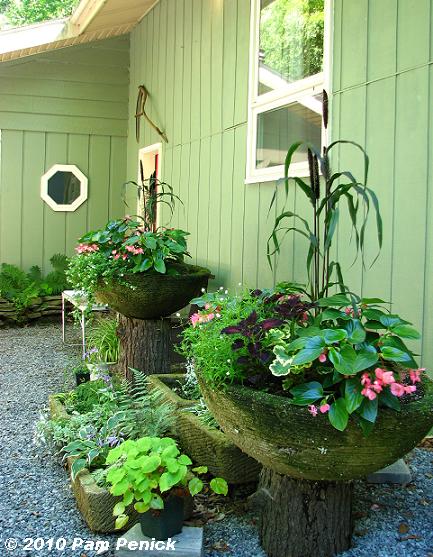
In the hubbub of the upcoming holiday I nearly forgot to post for Foliage Follow-Up. But recently I’ve had some fun adding colorful potted plants to my entry garden, and since I chose them for their shape and color, not blooms, here they are.

I’ve had this tall, green pot for a while, previously planted with a ‘Red Star’ cordyline. But the cordyline was looking ratty, and one day I saw this handsome ‘Sticks on Fire’ euphorbia for sale at The Great Outdoors, so I snapped it up, dug out some soil in the green pot, and popped in the potted euphorbia. It sits deep enough so that its plastic nursery pot doesn’t show. I’ll have to lift it out and take it inside when a freeze is forecast, but those are few and far between in a typical Austin winter.

Also, I’ve decided you can’t go wrong with a ‘Color Guard’ yucca, so I added another one in a smaller, dark-gray pot in front of the green container, and wow, does it pop against that emerald background! Blue-gray Mexican beach pebbles make a pretty mulch, and the yucca, being cold-hardy, needs no winter protection.

In the background, an evergreen ‘Alphonse Karr’ bamboo softens the corner and adds a vertical accent between the garage and the house.


A wider shot: this is my new foundation planting, a gravel garden to the left of the front door. From left to right along the foundation: bamboo muhly (Muhlenbergia dumosa), frost-bitten Mexican bush sage (Salvia leucantha), toothless sotol (Dasylirion longissimum) in the pipe planter, and Agave gentryi ‘Jaws’ in the circular planter. Bold, architectural, and, except for the salvia, evergreen—it makes me happy.


A closer look at the always wonderful ‘Color Guard’ yucca. ‘Color Guard’ is hardy to zone 4, and the deer leave it alone in my garden.


More traditional, and happy in the cool shade of live oaks on the north side of the house, this Japanese maple (a species Acer palmatum) is putting on its usual fall show at Christmastime. Its colors are more subdued this year, but I like how the new dry stream and fringe of transplanted river fern (Thelypteris kunthii) at its feet set it off.

Join me in posting about your lovely leaves of December for Foliage Follow-Up, a way to remind ourselves of the importance of foliage in the garden on the day after Bloom Day. Leave your link to your Foliage Follow-Up post in a comment. I really appreciate it if you’ll also include a link to this post in your own post (sharing link love!). If you can’t post so soon after Bloom Day, no worries. Just leave your link when you get to it.

All material © 2006-2012 by Pam Penick for Digging. Unauthorized reproduction prohibited.

Tait Moring’s garden with a view


You’ve all been very good this year, and Santa says there’s time for one more garden tour before Christmas, so here you go. I visited this garden in late October, at the invitation of owner/designer Tait Moring, who had it all spruced up for a busload of folks from the Garden Club of America. Lucky (pushy) me—I arrived early, before the bus rolled in, and was treated to an unhurried personal tour. What a relaxed host! Some of you may remember that I posted about Tait’s garden in the spring of 2011, when it was on the Wildflower Center-sponsored Gardens on Tour. He’s made some changes since then, of course, and it was also a treat to see the garden in a different season.

Pictured above is the front entry of Tait’s home, which is located in Westlake right off busy Bee Caves Road. Tucked behind a tall screen of cedar posts and greenery, you’d never know the home (and design office) is hidden away just off the road, a surprisingly spacious property that overlooks a forested canyon. The modest, painted-brick ranch has a clean-lined, concrete front porch set off by a raised pond and fountain cloaked in fig ivy.


On the front porch, a collection of pots attracted my attention. The largest was appealingly top-dressed with colorful glass beads.


These smaller pots, made by local artist Rick Van Dyke, resemble dinosaur eggs. I’ve seen Van Dyke pots for sale recently at The Great Outdoors. (Adding to Christmas wish list…)


A wider view of the front of the house. Tait has a generous decomposed-granite parking area for guests and clients. The rock wall at left of the house has a gate that leads to the private back garden.


A trio of giant hesperaloe in tall, bronze pots balances an asymmetrical window, and a fourth pot concludes the line just past the window. A meadowy mix of two species of ornamental grasses softens the base of a low wall.


I really love this and am tempted to steal the idea.


The rock wall includes a triangular niche.


Found objects and rocky treasures are tucked among the mortared stones, becoming part of the wall too.


Step through the gate and you enter the back garden, which includes a lawn leading to a new swimming pool. Previously a ramada-shaded patio stood at the end of the lawn, but Tait decided a swimming pool was needed to get through Austin’s long, hot summers. (I totally agree, whether you swim in your own back-yard pool, Barton Springs, or one of the many city pools; cool water up to the neck is essential.) Tait told me he got a little grief during one of his garden tours about having a lawn, but he likes it for the entertaining space and says it’s pretty low maintenance. To my mind, these are perfect reasons to keep some lawn: you’ve reduced it to what you use, you keep it for a definite purpose, and you’ve planted a lawn grass that doesn’t need coddling. His lawn is a soothing, cooling counterpoint to the rest of the property, which is either planted heavily with natives and adapted plants or, along the canyon’s edge, left wild and natural.


A fall-blooming daisy tumbles around a birdbath in one of the planted borders.


Looking back, I stopped to admire the curved cedar post that arches over the gate. Such interesting touches add so much delight to the exploration of Tait’s garden. On this side the wall shelters a small seating area.


Tait told me an interesting story about his stone columns (he has several; for a front view of the carved detailing, scroll up a few pictures). He and his crew were digging around in an old quarry on a Hill Country ranch where they were doing some work when one of his crew spotted the carved stone lying amid the rubble. They pulled it out and found this treasure—well, several of them. Who knows how long they’d been lying abandoned in the quarry, and he wishes he knew something about their history. But now they adorn his garden, standing like door posts on either side of the lawn, topped with terracotta bowls of agave and silver ponyfoot. The pink vine climbing the column is mandevilla, a tropical vine that needs winter protection.


From the middle of the lawn, looking back, you see the side of Tait’s house, with a row of native Lindheimer muhly grasses softening the foundation.


A closer look


And a wider view


Tucked into the shady border alongside the lawn, amid Salvia coccinea, holly fern, river fern, and ivy, a fountain bubbles up out of a drilled stone.


The rectangular pool is backed by an irregular stone wall topped with staggered-height cedar-pole fencing and softened with lush, tropical-looking plants, giving the space a Mexican or South American vibe.


A tiki-style stone-head planter atop another carved column from the quarry adds to the sense of tropical mystery, as do bromeliads atop the wall.


Some of the tropical-looking plants along the wall are actually quite hardy and drought tolerant, like feathery bamboo muhly (Muhlenbergia dumosa) and giant hesperaloe (Hesperaloe funifera).


Just past the pool (you can see the house in the distance), cedar-mulched paths lead through the trees along the canyon’s edge, and down into the canyon too, as far as Tait’s had time to work on them. This small clearing provided a place for a colorful hammock strung between two cedar (juniper) trees.


Seven-foot-tall mounds of native daisies were in flower along the path, especially where the tree canopy was thinner. It was amazing to walk through these golden berms.


This trail led past one of the special features of Tait’s property: a beautiful, old Texas madrone (Arbutus xalapensis), more commonly found in the Hill Country to the west. Its smooth, white trunks seemed to glow under the leafy canopy. Texas madrone is picky about where it grows in ways not fully understood. Tait said that although he’s cleared out a bunch of cedar (juniper) trees in this area, he left the ones around the madrone. He’d heard of a rancher who cleared out the cedars around a colony of madrones only to watch the madrones die as a result. Perhaps there’s a symbiotic relationship underground, in the roots and the living soil?


I had to reach out and stroke the madrone’s smooth bark.


Just past the madrone, at the canyon’s edge, the trees open to this—a stunning Hill Country view. With rock found on his property, Tait built a stone circle with a fire pit in the middle, which overlooks the canyon. Because of the ongoing drought and burn ban, he hasn’t used it once, he said. But he built it, he explained, as an expression of hope that one day the drought would end and the rains would return. Fire or not, the stone circle is a lovely place to sit and take in the view.


I spotted a pretty cluster of frostweed (Verbesina virginica) on the walk back to the house.


More trails lead from the gardens down into the canyon.


A stone retaining wall marks the boundary between garden and wildscape. A berrying yaupon holly straddles the wall.


Moving around to the other side of Tait’s garden, an ornately wrought, nature-themed gate set between stout cedar posts leads to…


…a vegetable garden that stair-steps along the canyon’s edge. Beautiful stonework defines raised beds…


…and stairs back up to the house. Behind the cedar-pole screen at the top of the stairs is a rustic outdoor shower.


At the back of the house, a patchwork path made up of paving samples leads past the outdoor shower to a back deck.


The small deck overlooks the canyon and looks back to the lawn garden too.


Another Rick Van Dyke pot, planted with pencil plant (Euphorbia tirucalli), sits on a table.


A wider gate, matching the one that leads to the vegetable garden, separates one end of the driveway from a work area in back.


Snake detail


A fountain made of an industrial-looking steel pipe and a stock tank helps to drown out traffic noise along the street-side of the garden.


And a focal-point pot in the center of a small, circular lawn backed by bamboo and cedar trees offers an interesting vignette right before you leave.

I’m grateful to Tait for this tour of his beautiful and fascinating garden. What a treat! For more images of Tait’s garden click for my spring 2011 visit.

All material © 2006-2012 by Pam Penick for Digging. Unauthorized reproduction prohibited.

Austin Open Days Tour 2012: Garden of Yvonne Tocquigny


My second stop on Saturday’s Garden Conservancy’s Open Days tour was the courtyard garden of Yvonne Tocquigny and Tom Fornoff, located in West Austin’s tony Tarrytown neighborhood. Elegant but relaxed and beautifully designed, this garden has a secret-garden aspect, with green walls erected in front and in back to define garden rooms, provide privacy, and screen unwanted views.

From the street you see a lawnless space with a gravel forecourt, a large island bed newly planted with sedge, with silver ponyfoot spilling over the raised edge, and crepe myrtles and variegated dianella flanking a gated entry in a wall cloaked in fig ivy.


A closer look reveals oversized bowl planters on limestone plinths, planted up with an evergreen shrub and white cyclamen, and a glimpse of Wedgwood blue doors. French-style lanterns hang on the ivy-covered wall.


The sedge in the foreground is probably either Berkeley or Texas sedge. I’m betting Berkeley—it’s fuller and more beautiful than our native sedge and just as hardy, and it’s showing up in designer gardens all over town.


Classy bowl planters with cool-season cyclamen


Step through the gate and your attention is drawn to the left by the trickling of a fountain that feeds a negative-edge trough housing goldfish and a single water lily.


To the right, Berkeley sedge (I think) creates a tufted, no-mow groundcover under yaupon or possumhaw hollies, with a large oakleaf hydrangea at back-right. A solid limestone block is a simple bench.


A boxwood topiary accents the front door.


Stepping back out to the forecourt and following a discreet path around the garage, you find yourself in a side yard that’s been turned into a lovely garden room, not merely a pass-through space. Cut-limestone pavers (or concrete that skillfully imitates limestone) set in gravel lead to a side door and around to the rear garden. A line of crepe myrtles planted in a raised bed adds privacy along the fence line.


To the right, along the house, a metal-and-wood-slat trellis with rambling roses creates a leafy and flowering scrim. Lanterns are mounted directly on the trellis.


It’s a delightful surprise to see the house framed in this manner.


Continuing down the path, you look back and see this view, with the raised bed with crepe myrtles on the right and a simple limestone bench tucked between boxwood rectangles.


A closer look at the bench


The entrance to the back garden is marked by an arbor entry, a continuation of the metal-and-wood-slat trellis that frames the house. Evergreen, glossy-leaved star jasmine cloaks the arbor and offers creamy, fragrant flowers in spring.


Step through the arbor and the formal, courtyard-style garden opens up to view, with an unattached guest house/studio framing the far side. Four indented, rectangular raised beds frame a stone, urn-style fountain set in a round, limestone-edged pond. It’s a beautiful, serene, inviting space.


The small pond is softened with papyrus and other water-loving plants.


At the back of the garden, a metal-and-wood arbor shelters a dining table, enclosed by a horizontal-slat fence that screens a less-than-picturesque arroyo from view (as I heard the owner say). Those are my friends Diana and Catherine peering through the fence to see what’s back there.


Potted bamboo in front of the slat fence adds a hint of Asian style.


Looking back across the garden you see the whole scene: vine-smothered trellis screening the house and framing French doors that open into the garden; formal raised beds crowded with yellow-blooming iris, softened by ferns that have “escaped” at the base; the symmetry of potted, cone-shaped topiaries that mark the doorways; and the splashing fountain in the center. This is a low-maintenance garden with a limited, restful, mostly evergreen plant palette.


Yvonne’s garden is featured in the book Tomorrow’s Garden, from which I learned that she worked with two separate designers to create this garden: Berthold Haas and Patrick Kirwin.


I loved the horizontal slatted arbor attached to the eave of the guest house/studio. At the far end of the garden, atop a low stone wall, a wooden lattice screens the neighboring house from view and provides a pretty backdrop for a rusty Japanese maple.


A garden bench sits under the maple, with a fringe of river fern on either side.


Looking back at the arbor-sheltered seating area


The view through the arbor doorway to the side-garden path. This is a finely crafted garden, very lovely and a treat to visit.

Up next: The garden of renowned landscape architect Christine Ten Eyck. For a look back at the eclectic and romantic garden of Jennifer and Fred Myers, click here.

All material © 2006-2012 by Pam Penick for Digging. Unauthorized reproduction prohibited.