
No rain, no watering: Imagining a drier future for Austin & its landscaping industry


Photo courtesy of Lee Clippard at The Grackle

Are we brave enough to look the worst-case scenario in the eye? Let’s lay it out: the rains don’t return this winter, at least not sufficiently to ease our exceptional drought, and next summer Austin enters Stage 3 watering restrictions, in which all landscape watering must cease.

Gulp.

Thursday evening I attended a brainstorming session with approximately 40 Austin landscaping professionals—garden designers, landscape architects, horticulturists, educators, growers, retail and wholesale nursery workers, arborists, green roof experts, aquifer management folks, garden-book authors, conservationists, Wildflower Center staff, and others—at which moderator Rich Zarria asked us to imagine this scenario and, war-room style, start thinking and talking about how the industry and we as individuals can evolve to meet the challenge. He and the other organizers convened the meeting because they feel it’s high time everyone started discussing the implications of an extended drought rather than passively hoping and praying for rain and keeping on with business as usual. Neither he nor anyone else there had answers, only the hope that by talking together we can come to grips with the situation and plan for the future—preferably a hopeful one.


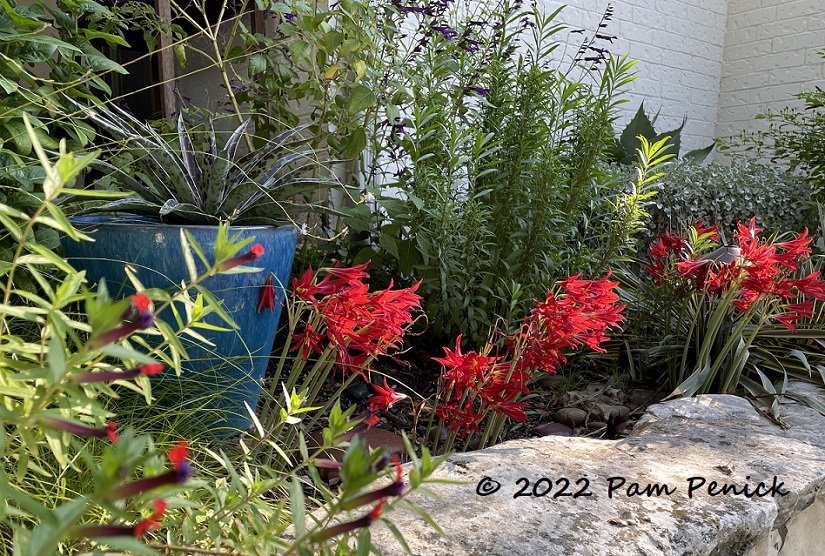
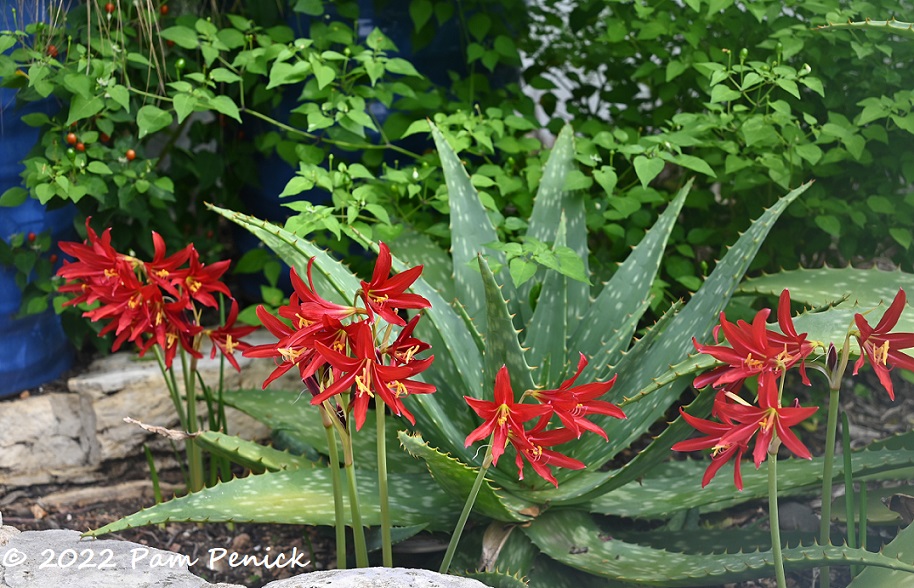
Lace cactus

Here are some questions to muse on, some posed by Rich, some by people I conversed with, some by me:

If we can’t water next summer, what will that mean for our city’s natural landscape, our personal gardens, our clients’ landscaping, and Austin’s already stressed tree canopy?

How can industry professionals keep their businesses (landscaping services, nurseries, etc.) alive?

Should we lobby for more water, at the expense of industrial usage or the water-guzzling rice farmers downstream? Is food production more important than ornamental landscaping? Is rice farming appropriate where there’s not adequate rainfall to support it? What is the worth (economic or otherwise) of ornamental landscaping and gardens that depend on at least some water?

What do we, as experts, tell the non-gardener homeowners who will be shocked to see their traditional landscaping die without water? Do we advise them to re-sod with St. Augustine, or perhaps Bermuda, when the rains return? Are native plants the answer? Should the city mandate which plants are OK to plant and which are not?

Can we figure out ways to popularize gray-water irrigation and rainwater collection systems?

Can we convert HOAs that have archaic landscaping rules that include traditional lawn grass (which won’t survive without water) to a new, dry-garden aesthetic?

Should we switch to a desert plant palette, even though we’re likely to have occasional rainy years interspersed in the drought years?

When the rains return and lakes fill again, as they will eventually (whether it be in the next couple of years or next decade), do we return to business as usual or evolve in a new direction, knowing that drought will inevitably return?

Rich’s gloomy scenario was tempered by his optimism that together we can come up with ways to get through this crisis, and that Austin is uniquely positioned to rise to the challenges. We didn’t choose this scenario, we all desperately wish we weren’t faced with it, but we have no power over what Mother Nature throws at us. The only thing we can control is our response. Austin is known as a green city, Rich pointed out, and we can lead by example.

I’ll geek out here and quote Tolkien: “I wish it need not have happened in my time,” said Frodo. “So do I,” said Gandalf, “and so do all who live to see such times. But that is not for them to decide. All we have to decide is what to do with the time that is given us.”

Your thoughts?


Lace cactus in bloom

All material © 2006-2011 by Pam Penick for Digging. Unauthorized reproduction prohibited.

The long view: Reflections on Austin’s drought


The approach of autumn is a hopeful time for the central Texas gardener. It means we’ve survived another long, hot summer and can enjoy being outdoors again. It means time for the rains to return to revitalize the summer-weary garden, replenish our aquifers and lakes, and offer the promise of wildflowers in the spring.


But as the fiery summer of 2011 crackles to a close I’m not sure that we can count on those certitudes this fall. Another La Nina weather pattern means a forecast for a drier than normal fall and winter, followed by another hot, dry summer. As I drive through Austin’s neighborhoods that back up to unwatered greenbelts, I see ghostly live oaks, half defoliated or entirely dead, dropping ancient limbs that had withstood previous centuries’ tests. Seemingly indestructible crepe myrtles are brown and withered. Underbrush is coppery and sere, just waiting for a stray cigarette butt to burst into flame.


The sky has been unrelentingly rainless (today’s brief showers notwithstanding). The LCRA reports that “[t]he 11 months from October 2010 through August 2011 have been the driest for that 11-month period in Texas since 1895, when the state began keeping rainfall records.”


In addition we’ve had record heat. Ronny Bell at The Lazy Shady Gardener recently provided some grim weather statistics:

As of today [9/16/11], we have experienced 85 days with a high temperature at or above 100 degrees. The average yearly number of 100 degree days in Austin, Texas is 13.5 – I’m thinking this year will be pushing that average up quite a bit. The previous yearly record for the most 100 degree days was 69 set in 1925 – that record has been absolutely shattered.


But we who love nature don’t need these facts to tell us something bad is happening. Anyone with eyes can see it in the suffering trees, gardens, and wildlife of our city. You can feel it in your heart.


Why now, one may ask? Why did this drought of record have to occur during my time in Austin? I’m sure some of my clients are asking Why? as they see some of their new drought-tolerant plants suffer and die. Of course, drought-tolerant is far from drought-proof, especially when newly planted, and even experienced gardeners are watching with dismay as established, xeric plantings die off because of the lack of rain. Hitch this existential Why? to the attendant guilt for caring about one’s own little eden when so much more is at peril if we don’t soon get rain, and lots of it, and you have an inkling of the local gardener’s psyche.


Like many Austin gardeners I know, I’ve been moody and sad. I’ve vacillated between despair over the changing landscape, worry for the future of Austin’s drinking water supply (for who can really complain about not being able to water when our fresh-water supply continues to drop alarmingly?), and sorrow for the loss of what ultimately may be thousands of trees that have helped make Austin the leafy, green city I’ve always known.


And yet Austin has endured cycles of drought many times before. My husband’s grandmother once told me about the 10-year drought of the 1950s. “It killed off even the trees,” she remarked solemnly. I couldn’t imagine such a thing at the time, but here we are again. Trees do grow back, though maybe not for the drought survivors to ever see to maturity. However, worse things have happened, and do. We should count our blessings and take the long view.


And so that’s what I’m determined to do from here on out—try to be philosophical and less moody. Not Pollyanna-ish—I don’t believe we’ll be back to our old weather patterns any time soon—but clear-eyed and calm. Plants will die. Eventually we’ll plant new ones that are able to withstand longer periods of drought. We’ll adapt to the new reality. We’ll still hold out hope for our gardens, and for wildflowers in the spring. We’re gardeners. We take the long view.


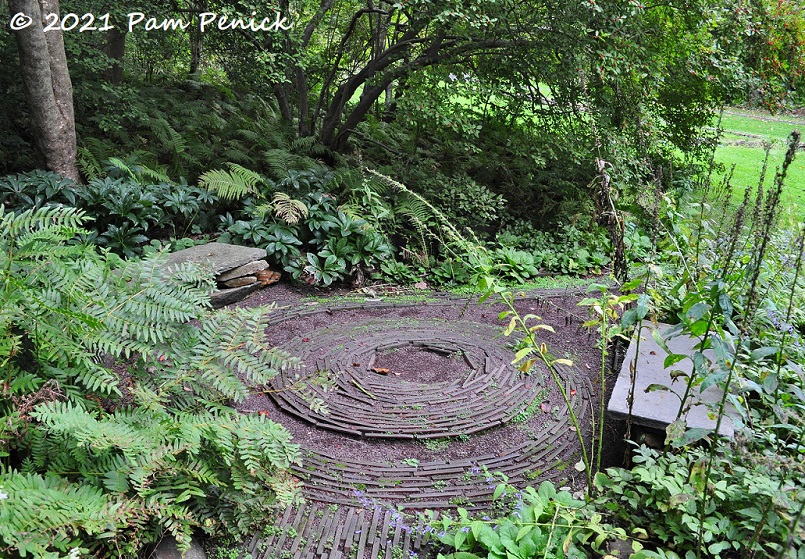
The photos here are of my front and back gardens, freshly mulched, all the dead plants trimmed out and hauled away, looking pretty good all things considering. I took these “long view” pictures on Friday to record the garden at this moment in time—the survivors of the summer of 2011. And now, here’s to the future and our gardens, come what may.

All material © 2006-2011 by Pam Penick for Digging. Unauthorized reproduction prohibited.

Read This: How to Steal Like an Artist


It may seem like I’m taking a break from garden writing to tell you about two Austinites whose websites are inspiring me this week, but there’s a connection. You’ll see.

First is Austin Kleon, author/artist of the book Newspaper Blackout. His inspiring and yet practical post How to Steal Like An Artist (and 9 Other Things Nobody Told Me) generated 1000 comments in 3 weeks before Austin disabled additional comments to keep from overloading his page.

It’s gone viral. So chances are you’ve already read it, but if not, you should. Why? you ask. I’m not an artist. Oh yes you are! If you love to garden you are definitely an artist, and his advice is for you. Do you love to write about gardening? I’m talking to all you bloggers now. His advice is for you too.


His first tip is, of course, “Steal like an artist.” He writes, “Every artist gets asked the question, “Where do you get your ideas?” The honest artist answers, “I steal them.” I laughed when I read that because just today I confessed “I totally stole that idea” to a visitor who exclaimed over my succulent-planted cinderblock wall. Austin says that artists understand that nothing is original, and that fills him with hope. Me too.


Tip number two is “Don’t wait until you know who you are to start making things.” Or, to put it more succinctly, “Fake it ’til you make it.” To me this means, Don’t worry that you aren’t talented enough to make that garden you’ve always dreamed of. Don’t worry about people thinking you’re a fake when you call yourself a writer. The process of doing, Austin suggests, is what makes you who you are, not the opposite. This too is a liberating idea.

Check out the rest of Austin Kleon’s advice about being an artist—or, really, about living a full life—on his website.


The other Austin writer who is inspiring me lately is the one who turned me onto Austin Kleon. She was also one of my co-panelists at SXSWi, Tolly Moseley of Austin Eavesdropper. Three things I noticed when we met: she has a megawatt smile, fiery red hair, and personality to burn. She seemed like such a people-magnet extrovert that I couldn’t quite imagine her blog being anything but glossy and superficial.

Boy, was I wrong. I started reading Austin Eavesdropper about a month ago and am now addicted to her introspective but often wildly funny posts. Her blog isn’t easy to categorize. It’s an autobiographical exploration of place (Austin) and anything she’s drawn to, mostly art, music, food, and fashion. Check it out and see if it inspires you too.

All material © 2006-2011 by Pam Penick for Digging. Unauthorized reproduction prohibited.