
July 30, 2010

Color Guard yucca & other deer-resistant color

Filed under: 2nd garden--2010, Xeric plants, Yuccas — Pam/Digging @ 7:50 am


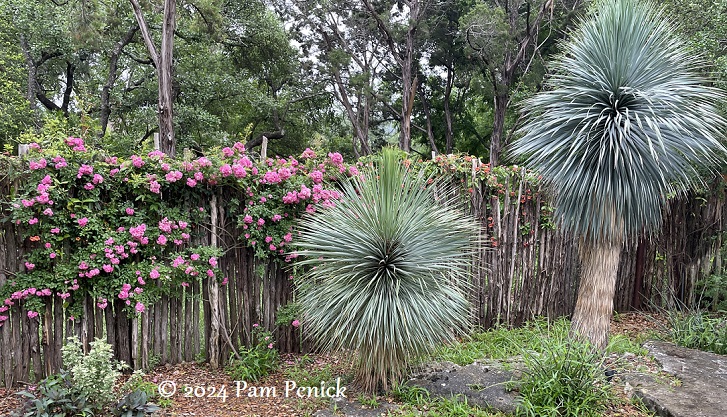
It shows an incredible amount of restraint that I have not planted my entire garden with nothing but ‘Color Guard’ yucca (Y. filamentosa ‘Color Guard’).


That color! The starburst form! Those curly, white filaments threading through the sword-shaped leaves!


This deer-resistant, drought-tolerant “shrub” will grow in full sun or part shade (in a hot climate), and it’s cold-hardy to zone 5. Frances at Fairegarden in Tennessee grows several ‘Color Guard’ yuccas in blue containers—yum!


Of course, restraint is the better part of valor, and not planting my entire garden with yucca means that I can play with other deer-resistant plants, like pale pavonia (P. hastata).


Native to South America, it’s a cousin of our native rock rose (Pavonia lasiopetala). Both have a reseeding habit and flowers that open in the morning and close in the afternoon. The pale flowers of hastata glow in the dappled shade of live oaks. A wine-colored eye and veins make them even prettier.


On the sunnier side of the bed, ‘Senorita Rosalita’ cleome has not been sampled once by the deer.

I’m starting to feel the planting itch again. How about you, southern gardeners? Are you counting the weeks until the Death Star switches from high beam to low (or at least medium)? Just two more months to go until we get a break from the heat and can plant to our hearts’ content. Just one month if we want to “cheat” and start early. Or did you never stop for summer?

All material © 2006-2010 by Pam Penick for Digging. Unauthorized reproduction prohibited.

July 28, 2010

Senorita Rosalita cleome mystery

Filed under: 2nd garden--2010, Plant trial, Xeric plants — Pam/Digging @ 10:10 pm


I’ve been touting the delights of ‘Senorita Rosalita’ cleome since trialing two in my back garden last year. Through terrible drought and heat, those cleomes grew bushy and full and bloomed nonstop until fall. Last winter killed them off, but naturally I bought two replacements this spring when I found them at Natural Gardener.


Sadly, one began to decline right away, and I ended up pulling it out in case it was diseased. By then I couldn’t find a replacement anywhere, but Daphne Richards came to the rescue and gave me two that she didn’t have room for, both from Home Depot. I planted one next to the survivor from Natural Gardener; the other went into the afternoon-sun bed I’d just created in the front yard. Since then, both the N.G. and the H.D. ‘Senorita Rosalita’ cleome in the back garden have failed to live up to last year’s plants. They are thin, straggly, and small—not at all what I fell in love with last year.


But the H.D. plant out front? Well, just look at it. It’s as full and flowery as the two I grew last year. I don’t know how to account for it. It’s obviously not a nursery issue. It’s not a placement issue because the two poor plants are growing where last year’s plants thrived. The only variable that I can think of is the weather. Last year it was brutally hot and dry. This year it’s been hot, but we’ve had some rain.


At any rate, when ‘Senorita Rosalita’ is good, she’s very, very good, and if you bought one on my recommendation, I certainly hope she looks fluffy and flowery. Because when she is bad, she’s horrid.

If you’re growing ‘Senorita Rosalita’ cleome in the Austin area, I’d love to hear your experience with it, for comparison’s sake.

All material © 2006-2010 by Pam Penick for Digging. Unauthorized reproduction prohibited.

July 27, 2010

Garden Designers Roundtable: Move over, prom queens! Give other plants a chance


Image courtesy of morgueFile

Do certain gardens remind you of high school, where everyone orbits around the popular girls—Rosa (KnockOut), Stella (D’Oro daylily), and Myrtle (crepe)—simultaneously admiring their peppy beauty and begrudging their general domination? I’m not talking about mean girls. After all, Rosa, Stella, and Myrtle are as nice as can be, undemanding and sunny. But when they are always elected prom queen, cast in every school play, and chosen to lead every club, it can get a little oppressive. Don’t let your garden be like high school. Invite some of the less popular kids to join the in-crowd by choosing a few of the following underutilized plants.


‘Sparkler’ sedge (Carex phyllocephala ‘Sparkler’). Do you have a dark, shady corner? Forget about those prom queen impatiens. Instead brighten up the shade with the cream-and-green evergreen stripes of Sparkler sedge. I find it performs best in bright or dappled shade; it will not be happy with long periods of direct sun, particularly afternoon sun. I expected it to be thirstier when I first planted it, but it has proven fairly drought tolerant once established. More good news: deer ignore it. Last winter’s deep freeze turned some of the lower leaves brown, but the plant survived with no protection. The only downside is that it can be difficult to find in nurseries. I’ve seen it locally at both Barton Springs Nursery and the Great Outdoors but not consistently. Your best bet, Austin gardeners, would be to call one of these nurseries and put in a request now for a spring shipment.


‘Black Pearl’ ornamental pepper (Capsicum annuum ‘Black Pearl’). This goth girl is my new favorite annual. Dressed in dramatic black leaves, she doesn’t give a flip about being prom queen. She won’t stop traffic with colorful flowers. But she knows how to create drama with dark foliage that contrasts beautifully with the brighter hued leaves and flowers of her garden companions, and she accessorizes with stunning, black, pearl-like peppers that turn red as they ripen.


Part sun to full sun increases the blackness of Pearl’s leaves; she’ll need a little extra water when it’s really hot to stave off wilting. You’ll find her in early summer at independent nurseries and the big home-improvement stores.


Sotol (Dasylirion). Agaves are deservedly popular here in central Texas, but sotols are the forgotten stepchildren, probably because they are less than impressive in a 1-gallon pot. After a few seasons in the ground, however, sotol grows into a spherical, shimmering focal point, catching the light with hundreds of tiny teeth arrayed on flexible, strappy leaves. Heat, cold, and drought tolerant, it requires only plenty of sunlight and sharp drainage to do its thing. Wheeler’s sotol (Dasylirion wheeleri), pictured above, is my favorite because of its blue coloring. Native to west Texas and the desert southwest, it grows well in Austin with good drainage.


Gorgeous in green, Texas sotol (Dasylirion texanum) is native to central Texas and can be spotted growing wild on rocky escarpments. Both varieties, as well as a few others, are easy to find at independent nurseries like Barton Springs Nursery and the Natural Gardener.


Agastache. I planted a number of agastache in the spring of 2009. Now I wonder how I ever got along without them. These desert-southwest natives need good drainage, lots of sun, and a little elbow room to avoid powdery mildew, but when you find the right spot and give them a couple of seasons to get established, they really put on a show. Agastache has an airy form of tiny leaves on upright stems, just like many of our native xeric plants. It won’t look like much in a one-gallon pot. But after a season or two in the ground it takes off and puts on a colorful show from mid-summer through fall with tubular, hummingbird-attracting flowers. Agastache ‘Desert Sunrise,’ pictured above, is one of the best performers in my garden.


Agastache ‘Acapulco Salmon & Pink’ is also rocking out in combination with cleome, phlox, and ‘Black Pearl’ pepper. The common name “licorice mint” gives a clue that agastache’s leaves are fragrant, which also means deer don’t like it. Check out High Country Gardens online for a good selection. (Full disclosure: Owner David Salman sent me a collection of agastache as the prize for a photo contest back in 2009.)


Snapdragon vine (Maurandella antirrhiniflora). If you want a flowering vine that won’t overwhelm your arbor, much less your house, that loves heat and sun, try this deciduous, dainty climber with ivy-like leaves and purple, snapdragon-like flowers. It dies back in winter but is hardy to 20 degrees F. I cut mine to the ground after a few hard freezes turn it brown. In spring it quickly clambers back up, to around 8 or 10 feet if given adequate sunlight.


Snapdragon vine climbs by twining, so affix a length of thin wire or jute twine where you want it to go. I’ve found it for sale at Natural Gardener and Barton Springs Nursery.

So there you have it—five plants that will shake up the high-school pecking order in many an Austin garden. Keep in mind that these plants are suitable for central Texas growing conditions. If you live elsewhere I can’t speak to their suitability for your climate, but do check out today’s posts from the other participants of Garden Designers Roundtable to see what regional plants they suggest for the topic “Underutilized Plants.”

Andrew Keys : Garden Smackdown : Boston, MA
Carolyn Gail Choi : Sweet Home and Garden Chicago : Chicago, IL
Christina Salwitz : Personal Garden Coach : Renton, WA
Debbie Roberts : A Garden of Possibilities : Stamford, CT
Douglas Owens-Pike : Energyscapes : Minneapolis, MN
Genevieve Schmidt : North Coast Gardening : Arcata, CA
Jocelyn Chilvers : The Art Garden : Denver, CO
Lesley Hegarty & Robert Webber : Hegarty Webber Partnership : Bristol, UK
Pam Penick : Digging : Austin, TX
Rebecca Sweet : Gossip In the Garden : Los Altos, CA
Scott Hokunson : Blue Heron Landscapes : Granby, CT
Susan Cohan : Miss Rumphius’ Rules : Chatham, NJ
Tara Dillard : Vanishing Threshold : Atlanta, GA

All material © 2006-2010 by Pam Penick for Digging. Unauthorized reproduction prohibited.

July 26, 2010

A Call to Shovels! In Search of the Gen-X Garden

Filed under: Design, Garden philosophy, Guest posts — Pam/Digging @ 10:39 am


A guest post by Scott Calhoun

Over the past year, I’ve been traveling around the interior West, speaking to gardening groups, and as I scan my audiences, I’ve become worried that the demographics of gardening do not bode well for the future of America’s favorite pastime. I consider myself a passionate garden designer with a progressive approach aimed squarely at youthful thinkers, but at many engagements, I look around a room and find that, at a not-so-young 39, I’m the youngest person in the room. One could conclude that my material is not compelling to young gardeners; but when attending lectures delivered by better known and more charismatic gardening evangelists than myself, I encounter the same issue.

My generation is dropping the trowel. The paucity of youth at gardening events leads me to believe we are the entitled, lazy, sitcom addicts from broken homes clinging to the apron strings of the baby boomers that the media says we are—at least when it comes to gardening. We are spoiled string-cheese-eating kids who are scared to get our fingers dirty. We have ignored our elders and thumbed our noses at the great gardeners who would be our mentors; I’m beginning to wonder what will become of the gardening world after the boomers are gone.


Totem pole cactus and Mexican gold poppy against ‘Ripe Pear’ windowsill

As a garden designer and garden writer in the Southwest, an area with lots of retiree inflow, I sometimes feel as though my work consists of separating the so-called greatest generation from their last gardening dollars. Just like the Eternal Lawns Cemetery, my slogan could be, “I can design your final garden.” These gardens, while lucrative for me, often lack a certain vigor, and well . . . youth, because of restrictions imposed by aging clients and tyrannical homeowners associations that control everything from what species of plants you can plant to what color you can paint your walls. Gardens built with too many freedoms curtailed often fall short of artistry.

I’ve come to think that many of the great gardeners of the greatest generation didn’t move to Arizona or Florida. They weren’t looking for an easier lifestyle. Their retirement consisted of working the land to the end. My grandfather, Richard Graehl, was a case in point; he gardened right up until the end of his life. His retirement resulted in a masterfully planted five acres of corn, squash, berries, and alfalfa that kept him occupied in all but the coldest months when the soil was unworkable. Like many of his generation, gardening for Grandpa was a food production activity and ornamental gardening was purely recreation—one that he had precious little time for.

The boomers, on the other hand, know how to recreate; if you asked them, they would likely tell you that their generation invented recreation. When it comes to gardening, they are all about ornamentation. Sure, they buy organic veggies, but grow their own food? Please! Boomers wedge gardening between shiatsu massages and new age shaman consultations. Not only do they have amusing stories to tell about their counterculture days, they have money, like plants, and are not afraid to buck the status quo a little. One of best things about working with them is that they are open to new ideas. With boomers, gardening is moving forward, but what about us? What about Generation X?

Our slacker generation, Gen X uses the converse argument: “Because we don’t have any free time, we don’t want to spend much of it gardening.” Yes, time is a problem. We are working more hours than our parents did; we have kids; we live in generic suburbs. I understand all this, but come on, people. Can’t we muster a few creative gardens? Are we so removed from our agricultural roots that we’re nonplussed by the green side of the world? Doesn’t the constant buzz of technology make us want to stick our hands, and maybe our heads, in some compost?

I think ours is the best-equipped generation ever to do bold things in our gardens. After all, we are a generation that embraces change. We invented punk music, video games, and computers. We took junior high typing classes using manual typewriters only to move wholesale to computers in college. We supported the move from vinyl to compact disc and from CD to mp3. We moved from film to digital cameras and from handwriting to email. We rarely complained or made a fuss—we just changed.


Turquoise wall and Indian fig cactus in Tucson’s Barrio Historico

We were also raised in a more design-conscious world. Crate & Barrel and IKEA catalogs became our favorite bathroom reading. We don’t see style as a luxury, but as an essential part of who we are. Although we have largely given up status symbols like clothing embroidered with the Ralph Lauren polo horse, do not be deceived; we care a lot about what we wear and how we arrange our homes for living. Extending this proclivity to the outdoors doesn’t feel like that much of a stretch to me.

Like gifted children who are bored with everything, we have the skills but are slow to apply ourselves. I think this is mainly because we’re turned off by the old ways of gardening (i.e. gigantic lawns, excessive water use, chemical bombardment, and fussy plants). To me, the traditional American way of gardening seems silly and wasteful and generally out of place; I surmise that other Xer’s must feel the same way. So, while recognizing that there are many ways to get the young interested in gardening, I have a simple—and practically foolproof—recipe to follow. It’s a simple binary formula: bold colors and wild plants equal rock-and-roll gardens. World-renowned landscape architect Steve Martino boils down the genius of his work with bright colored walls and native plants to this same formula: “walls and weeds.” Walls and weeds are a remedy for blandness and a call to action among my slacking peers who seem to be fixated on Victoria’s Secret commercials, Seinfeld reruns, and eBay auctions. Snap out of it! Let’s get painting and planting!

Bold Color

Color powers and enlivens gardens. I’m not talking about the petunias and pansies that are sometimes referred to as “color;” I mean paint. Big architectural plants, which form the backbone of exciting gardens, need a stage or backdrop, and color-drenched walls are often exactly what is required. Colored walls are the garden design equivalent of putting a dancer in a neon pink leotard in front of a black velvet curtain—her silhouette pops out in relief. Young gardeners should be happy to jettison a palette of puritanical pastels for colors that flex their muscle and highlight the structural mettle of Dr. Seuss-style succulent plants.

If you think that color, in the form of paint, is simply window-dressing in a garden, consider the great spiritual and emotional pull of color. The great Russian modernist painter Wassily Kandinsky wrote, “Orange is like a man, convinced of his own powers.” Of red, he wrote, “Red rings inwardly with a determined and powerful intensity. It glows in itself, maturely, and does not distribute its vigor aimlessly.” On the color of the western sky, blue, Kandinsky says that it is the color of profound meaning. Our desert sands and rocks are blood-red, vermillion, and coral tinged with chartreuse lichens, these rocks are our guide to coloring our gardens.


Lupine and desert spoon against a cobalt blue wall

In our gardens, we need to take the color of the sky reflected in a desert stream, the fiery red crown of the Gila woodpecker, the screaming orange of a Mexican gold poppy, and selectively, with an artist’s intentions, paint those colors on a few of our garden walls.

In her book The Anthropology of Turquoise, Ellen Meloy points out that in humans, 70 percent of our brainpower is used for vision. Meloy calls vision “this tyrant of the senses.” Put a weak color in a garden and watch it recede to the blandness. Already largely oblivious to continental gardening traditions, young gardeners need to flex their color muscles, and they can do it with painted walls.

For a while, I considered the use of bold color on garden walls part of the desert garden design bag of tricks, but lately I’m more and more convinced that this will work anywhere. At the Cornerstone Festival of Gardens in Sonoma County, California, acclaimed garden designer Topher Delaney has constructed a garden consisting of a gravel-filled courtyard planted with white-trunked sycamore trees. As a backdrop for the trees, she uses a giant curtain of blue.

After looking at Delaney’s exhibit, I began to think about eastern gardeners planting white birch and witch alder and yellow-twig dogwood against blue walls. Or perhaps spicebush or a pagoda dogwood tree sidled up to turquoise seat wall. Adding snow and fall color to the design mix only seemed to increase the impact that a colored wall could have when combined with the spectacular plants of the Eastern deciduous forest. Yes, Martha Stewart devotees might question your taste and call for more subdued tones, but when you explain that you’re carving out a niche for your own previously black-thumbed generation in the gardening world, they are likely to be mollified.

The Martha followers should really be proud of you. Bold color is not an American tradition limited to the Western half of the continent; consider Fletcher Steele’s Blue Steps at Naumkeag in Massachusetts, which combine cobalt blue and paper birches in a way that can only be described as daring.


Snow pole cactus against terra cotta wall at Tohono Chul Park’s Desert Living Courtyard

Wild Plants Equal Wildly Fun Gardens

Gen-Xers are environmentalists at heart, so lacing up our hiking boots isn’t too much to ask. Some gardeners have a favorite steel shovel, cultivator, or pair of Swiss pruners, but my favorite garden tool is worn on my feet. For young gardeners, hiking boots are one of the best gardening tools. Hiking puts potential slacker gardeners in situ with wild plants. If gardening were more like hiking, or if being in your backyard felt like being out on a hike, more Xers would do it.

One of the best things about hiking and botanizing is observing the natural patterns of how things grow best. If we see coral bells (Heuchera sanguinea) hanging onto a rocky slope in the shade, we just might get the idea that coral bells like a shady well drained spot in the garden. It is this day-to-day association with wild plants that engenders respect for them, and hiking through a forest or desert is a fine and pleasurable way to make that acquaintance. It works like this: view the natural world, note it, photograph it, adapt it to your garden, find it at a nursery, buy it, and plant it.

Thankfully, the nursery industry has come around to the idea of growing and selling native and drought-tolerant plants that can make even the most self-righteous Whole Foods-shopping, Prius-driving, Sierra Clubbing Xer feel like gardening is a guilt-free activity.

Many of the wild plants, especially in the Southwest, are so iconographic and bold that they are more like sculpture than flora. This appeals to our contemporary design and IKEA catalog sensibilities: edited, clean, modern, sculptural. Using bold plants is a great way for Xers to sweep out the clutter of and reinvent our gardening selves. Why not start with plants? In my desert region, the ocotillo, the saguaro, the prickly pear, cholla and yucca can be arranged to preside over a desert garden without sucking out groundwater at an unsustainable rate.


Purple walled garden at the Arizona-Sonora Desert Museum

In cooler and wetter climes, many bold plants can easily be incorporated into gardens. I know a Massachusetts gardener who overwinters a bevy of agaves in a south-facing window just to enjoy their spiky personalities outside in the warm months. Even planted outside and in the ground, there are cold hardy prickly pear cactus and yucca plants that will thrive in nearly every condition.

Even for those who recoil at the idea of plants with stickers, there is plenty of pizzazz to be found in the world of ornamental grasses and spiky perennials. Slackers can create a tour de force by combining plants like gayfeather and blue oat grass, purple prairie clover and blue grama, firecracker penstemon and deer grass. Ornamental grasses are the new gardening wave that Xers should be riding.

If Gen-Xers are at all interested in making art of their gardens, and I believe that they are, there is no better place to start than with underused American plants. When choosing plants for youthful gardens, we would be wise to take Ezra Pound’s advice to young artists and “make the world strange.”

Instead of piercing and tattooing so many of our body parts to get attention, why not just grow some strange plants against big colored walls. Put a big Medusa’s head euphorbia (Euphorbia esculenta) out on the porch and you’re sure to at least get a few “that’s interesting” type comments from your neighbors. If the Medusa’s head isn’t strange enough, you could go with the curiosity plant.


Nolina and palo blanco against a pink and purple wall at the Arizona-Sonora Desert Museum

My New Gen-X Garden

As you can see, I’m ready to create these gardens, I’m just waiting for the right Gen-X clients to ring, email, or scream. Since the only voice screaming for this sort of garden seems to be me, I’ve decided to do the sensible thing and listen to the voices in my head.

I’ve been designing a new garden in a courtyard outside my office, and in it I hope to marry plants and paint to create spaces of tranquility and clarity and a little Gen-X attitude. Designing a garden for yourself rather than someone else is a sublime pleasure and something I believe that most people are capable of; all it takes is a willingness to make spectacular mistakes. In this respect, I am brimming with talent, as are many of my contemporaries.

This new garden is based on the color blue. I’ve been studying the gardens at Majorelle in Morocco, the blue walls of Steve Martino and Carrie Nimmer, and a blue walled courtyard garden at the Antique Rose Emporium in San Antonio, Texas, where owner Mike Shoup combined yuccas with blue paint to excellent effect. Frida Khalo’s garden, at least as presented in the film Frida, has also caught my eye. I’m seeing and thinking blue. Again, Ellen Maloy’s book, The Anthropology of Turquoise, has piqued my imagination and caused me to consider the combination of rock and sky, and of rock the color of sky (turquoise).

I drew my garden on paper. The perimeter of the garden is defined by a wall of corrugated steel, painted blue, its channels running horizontally. Against this backdrop, I’ll plant large silver-beaked yuccas and a desert museum palo verde tree, whose yellow blossoms would stand out like stars against the blue fence. The shape of the space, two rectangles, would be separated by a low ocotillo fence, making two distinct rooms. Like a Persian garden, a small central fountain would be centrally located. The fountain would consist of a sunken steel box with a bubbling urn sitting atop two salvaged steel storm grates. In an L-shape around the fountain, a flagstone bench and pedestals define the space. In various spots around the garden, I’ll place recycled blue and green steel drums that I poked holes in using the pointed end of a 17-pound digging bar. In these drums, I plan on locating bold desert specialties like ocotillos, elephant trees, and agaves.

A Call to Shovels

My admonition to my fellow Xers is this: put down the high-fructose, corn syrup-based drink in your hand and the Xbox remote control, and go out into your backyard. Look at it with new eyes: think about how you might make your yard a reflection of your fast-paced, highly designed, and highly interesting life. Get out there and start painting and planting. Let’s show the boomers how it’s done: grow a vine on a trellis of rusted bed springs; make a bullet-riddled propane tank a sculpture, and plant a white-trunked tree against a wall the color of deep water—like a snowy egret in a pool of cobalt glass.

________________________________________

My thanks to Scott Calhoun for permission to repost his article and photos, which first appeared on Terrain.org, No. 18: Spring/Summer 2006, where his bio explained that Scott “gets much of his design inspiration from badlands and taco stands, a style which Sunset magazine dubbed ‘Taqueria Chic.’” The author of several books, including the award-winning Yard Full of Sun: The Story of a Gardener’s Obsession that Got a Little Out of Hand, he also lectures and designs gardens in Tucson, Arizona. You can find him online at Scott Calhoun’s Desert.

I’ve been following Scott’s work since reading Yard Full of Sun, which made a big impression on me for its embrace of challenging gardening conditions, native plants, sustainable gardening, and general outlook on life. I’ve reviewed some of his other books, including The Hot Garden and Designer Plant Combinations, here at Digging. I’m currently reading Chasing Wildflowers and hope that Texas’ spring wildflower show and fish tacos will one day lure Scott back to Austin so that I can meet him. —Pam

All material © 2006-2010 by Pam Penick for Digging. Unauthorized reproduction prohibited.

Older Posts »

Powered by WordPress
All material © 2006-2010 Pam Penick. Unauthorized reproduction prohibited.