

September 7, 2008

Sweet September flowers

Filed under: 7th Year--2008, Texas natives — Pam/Digging @ 5:24 am


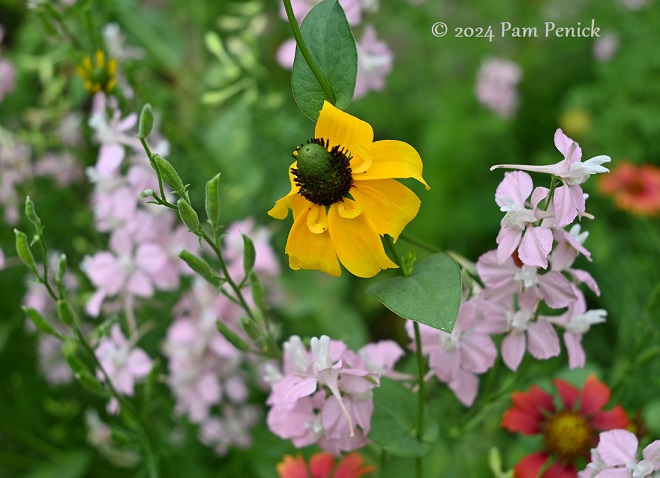
The cooler mornings lately have drawn me into the garden, and I’ve been taking more photos than usual. It’s impossible to resist these fat, pink rosebuds appearing on the ‘Belinda’s Dream’ rosebush.


The pillow-like flowers are even sweeter, with a dreamy fragrance.


The kidneywood (Eysenhardtia texana ), a tough, native, shrubby tree, is in full bloom, attracting moths, flies, bees and other eager pollinators. Its airy form makes it difficult to photograph, as Lee at The Grackle pointed out recently.


A close-up gives a better sense of its beauty. The flowers smell faintly like a mimosa’s, and the feathery leaves, when crushed, are lemony. It makes a modest accent tree that provides a little shade, but not too much—great for a xeric garden filled with sun lovers.


The year-old ‘Muskogee’ crepe myrtle in the front garden put most of its energy into growth during this long, hot summer. But it did flower, and here’s a look at its tissuey, lavender-pink bloom. I’m sorry not to be here to see this tree grow to maturity. I hope the next owners let it grow into a graceful, vase-shaped tree rather than hacking it back and creating knobby elbows every year. Maybe I should leave a set of instructions behind. Or would that be too pushy?

All material © 2006-2008 by Pam Penick for Digging. Unauthorized reproduction prohibited.

September 5, 2008

Who hired YOU to trim my tree?

Filed under: 7th Year--2008, Wildlife — Pam/Digging @ 10:26 am


For the second year in a row, my cedar elm (Ulmus crassifolia ) is being tip-pruned without my authorization. Every morning I sweep up the patio under the tree (I’ve got to keep things looking good for potential buyers), but only an hour or so later I see that the patio is littered with small twigs and leaves again.


The ends of the twigs look as if they’ve been chewed. Hmm, who is the culprit?


You’re busted, squirrel! You and all your buddies have been trimming my tree without the proper authorization. Don’t give me that look. I caught you red-pawed.


See? Here you are dangling by your hind feet, reaching for a twig to gnaw on. Yeah, I caught you and your delinquent buddies doing acrobatics in the tree yesterday morning, chewing and tossing. What’s more, looking out the window as I type this, I see that you’re at it again.


I insist you stop making a mess this instant!


What? You say these cedar elm seeds are tasty and you’re storing up for winter? Oh. Well, I guess the tree can spare a few twigs here and there. Go ahead, I don’t want you to starve.

But could you please sweep up after yourselves?

All material © 2006-2008 by Pam Penick for Digging. Unauthorized reproduction prohibited.

September 4, 2008

Hallelujah! A cool north wind

Filed under: 7th Year--2008, Birds, Texas natives — Pam/Digging @ 10:39 am


A cool north breeze surprised me yesterday and still blows today, bringing us the deliciously dry air and deep blue skies that we’d normally wait until mid-October to enjoy. Don’t get me wrong. We’re still seeing temperatures in the mid- to upper 90s (35.5 Celsius), but it seems almost pleasant without our typical oppressive humidity. And the last two mornings have been absolutely lovely. This is pulse-quickening weather. I’m cherishing the cool, fresh air.

You may be waiting for pics of our new house and garden-to-be, but that must wait until it’s ours in fact and not just pledged on paper. Until then, I hope you’ll be content, as I am, with the beauty my current garden is offering up as a final, parting gift.


The hummingbirds are busy, storing up for winter, I suppose. This one sups on our native rock penstemon (Penstemon baccharifolius ), also pictured at top.


The long stems of white-flowering Guara lindheimeri weave through Gulf muhly grass (Muhlenbergia capillaris ) by the cedar garden bench.


I’m pleased with the play of yellows and greens in the front agave bed. Agave americana Variegata’s stripes pick up the sunny yellow of our native hymenoxys (Tetraneuris scaposa ). Not visible in this image, yellow-flowering Jerusalem sage continues the color theme, as does a painted yellow bench.


A close-up of the agave’s ghostly leaf imprints.


The ‘Muskogee’ crepe myrtle that replaced the vitex last November has thrived, despite the hot, dry summer. Good ole crepe myrtles, you’ve gotta love them for their toughness, graceful form, and summer-long blooms, even if they are overplanted in the South. Hey, there’s a reason.


What post about the front garden would be complete without an image of the ‘Whale’s Tongue’ agave (Agave ovatifolia )? Here it is backed by Autumn sage (Salvia greggii ) in glorious pink bloom.


I hope you have a hallelujah moment or two in your garden today too. I’m going outside to drink in the north breeze.

All material © 2006-2008 by Pam Penick for Digging. Unauthorized reproduction prohibited.

September 2, 2008

Showy in the shade

Filed under: 7th Year--2008 — Pam/Digging @ 2:29 pm


The shorter days and cooler nights of late summer make this hot-climate gardener giddy with anticipation of fall, which around here means a return to the garden, to enjoying the outdoors, to our best planting season. While I sympathize with my northern friends who sense their gardening season winding to a close, I feel no autumnal melancholy. Rather, it’s like a second spring is right around the corner.

The shade garden seems to sense that excitement too. Reds and jewel-like purples are blazing. The oxblood lilies (Rhodophiala bifida ), pictured above, are faithfully reemerging, having waited out the hottest and driest summer I can remember in Austin. Welcome back!


Native turk’s cap (Malvaviscus arboreus ) has flowered all summer, and it’s still happily producing oodles of hummingbird-attracting flowers.


In the stock-tank container pond, dwarf papyrus (Cyperus haspen viviparous ) grows alongside horsetail (Equisetum hyemale ), not minding the encroaching shade of the nearby cedar elm. The water lily minds, however, and has bloomed less and less over the years. By the way, both dwarf papyrus and horsetail are aggressive when they have plenty of moisture. If a stem leans over and touches the water, a new plantlet will grow roots on the end of the stem. I keep both pond plants in pots without holes, but I must still trim leaning stems frequently.


American beautyberry (Callicarpa americana ), another native. This large beauty of a bush is well behaved, so long as it has plenty of room to arch and show off those long branches clustered with shiny purple berries.


The appearance of these berries, encircling each skinny, arm-like branch like beaded bracelets, cheers me up. They promise that fall is coming.

All material © 2006-2008 by Pam Penick for Digging. Unauthorized reproduction prohibited.

Older Posts »

Powered by WordPress
All material © 2006-2008 Pamela Penick. Unauthorized reproduction prohibited.