


New Year’s wishes for the garden
December 31, 2011 As we ring in 2012 tonight, here’s to a happy and bountiful new year in the garden. May you have plenty of beckoning flowers And glowing foliage Enough rainwater to slake the garden’s thirst Sunny days to lift your spirit and a shady spot to sit and ...

Agaves green up the winter garden
December 28, 2011 Southern gardens traditionally rely on evergreen shrubs for winter structure and greenery. In my Southern meets Southwestern garden, agaves serve the same purpose. Pictured here is ‘Moby,’ the white whale of my garden—‘Whale’s Tongue’ agave (A. ovatifolia), whose broad, cupped leaves, each serrated with thorns and tipped ...

Christmastime Autumn leaves for Foliage Follow Up
December 16, 2011 Although Christmas is only a week away, fall color is just now peaking in Austin. Buttery yellow cedar elms, rusty red oaks, and, in my garden, a red-orange Japanese maple brighten the neighborhood along with colored Christmas lights. Yeah, it’s a little disconcerting, but officially it is ...

Japanese maple leaves glow like stained glass
December 08, 2011 Our first hard freeze last night has coincided with the early coloring of leaves on my Japanese maple, a species Acer palmatum. It normally blazes red by mid-December, but I wonder if the drought will affect its fall color. I’ll soon know. Autumn is fading fast into ...

Copper canyon daisy appears, better late than never
December 06, 2011 Fans of copper canyon daisy (Tagetes lemmonii) had nearly given up on seeing the familiar mounds of golden-yellow flowers in Austin this fall. In conversations with other garden bloggers I learned that this xeric, fragrant-leaved perennial had died or suffered severely during our recent drought-stricken, sunburnt summer ...

Cinderblock wall succulent planter still going strong
December 01, 2011 When I stacked and planted it in early March, I expected to get about 8 months of color and interest out of my cinderblock wall planter filled with succulents, and I have! All through our raging summer it held up really well with minimal water, even when ...

New garden art and happy Thanksgiving!
November 24, 2011 Are you feeding your little chickies this Thanksgiving? So is my mama bird in this delightful sculpture by talented metalworker and fellow blogger Bob Pool of Gardening at Draco. At Draco Metal Works he can make just about anything you want, so long as it’s metal. Check ...

The colors of November in my garden
November 22, 2011 Pink is not a color one usually associates with autumn, but central Texas seasons are not necessarily traditional. Many of the perennials in my garden went quiet during the recent summer from hell, and now, with cooler weather and a bit of rain (yea!) they are blooming ...

The garden loves late October, and so do I
October 30, 2011 Is April the best month in the garden? May? No, surely it’s October, when the Death Star shifts its beam to the Southern Hemisphere, nights offer cool relief, and we even get an occasional rain shower. The garden, released from its summer thrall, responds with elation, bursting ...
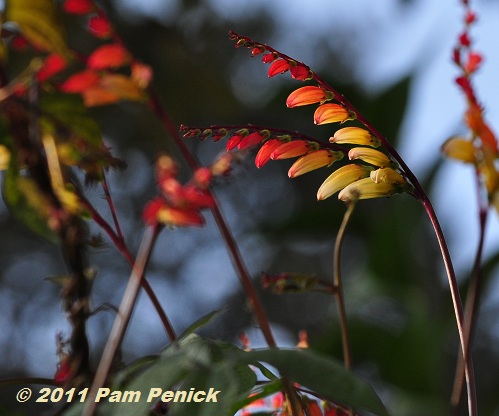
Plant This: Spanish flag, aka exotic love vine
October 28, 2011 A one-two punch of stunning photos on Meredith O’Reilly’s Great Stems and a positive write-up in Armitage’s Vines and Climbers sent me running to the seed rack at the nursery last spring. I bought a Renee’s Garden pack of Spanish flag vine (Mina lobata) and soon after ...

Getting the blues in the garden
October 08, 2011 A few more long views of the garden reveal just how blue and silver all my accessories are. I used to lean more to browns, golds, and rust, but perhaps I’m trying to visually cool things down these days. I even have a lot of blue and ...

Bees love butterfly vine
October 02, 2011 Butterfly vine (Mascagnia macroptera) is the only vine that really thrived in my garden this summer, thanks to the drought and unusually high temperatures. And now comes the payoff: lemon-yellow clusters of flowers that look as if they were cut out with pinking shears. The bees were ...

Flower pop! Hope blooms with the promise of fall
September 29, 2011 Another 100-degree day (37.7 C), and still no rain. But over the past couple of weeks we’ve heard actual thunder, spotted clouds (clouds!) in the sky, and occasionally seen temps dip into the lower 90s. A “cold” front tonight is supposed to bring us 90-degree days through ...
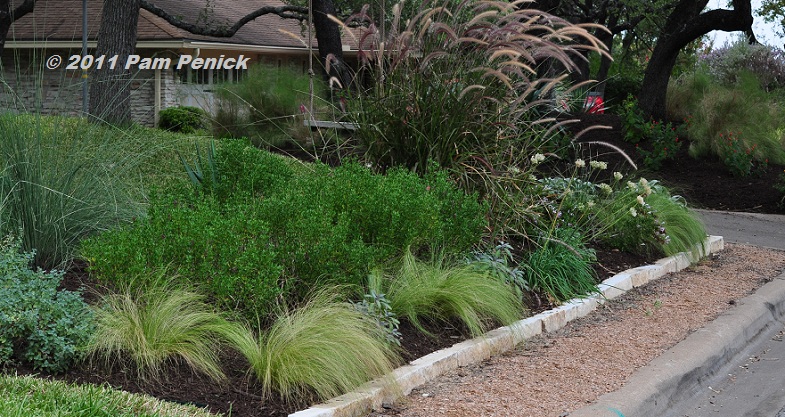
Streetside bed reduces lawn, welcomes visitors
September 21, 2011 Now that the promise of fall is in the air (yeah, it’s only going to be 96 F today in Austin), you might be thinking about that dead strip of lawn along the street and what to do about it. How about ripping out your “hell strip” ...

The long view: Reflections on Austin’s drought
September 17, 2011 The approach of autumn is a hopeful time for the central Texas gardener. It means we’ve survived another long, hot summer and can enjoy being outdoors again. It means time for the rains to return to revitalize the summer-weary garden, replenish our aquifers and lakes, and offer ...

Tiny Fern bamboo for Foliage Follow Up
September 16, 2011 Not that it’s been the easiest summer to try a new bamboo, a thirstier plant than I usually bother with, but they provide such leafy, touchable, evergreen texture in the garden that I’m willing to give ’em a little extra love, i.e., water. No thirsty annuals or ...
