
Streetside garden is greening up and filling in


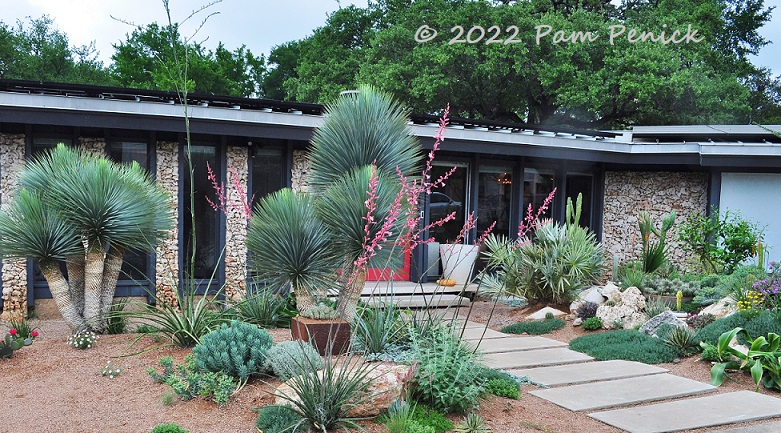
After last summer’s heat and drought, many local readers, I suspect, are ripping out burned-up lawn along the street and replacing it with drought-tolerant plants and hardscaping. That’s what I did a year ago with my own curbside lawn, putting in a decomposed-granite parking strip edged with chopped limestone and pushing back the lawn by several feet to make a pretty, deer-resistant garden of grasses, salvia, garlic chives, yucca, and catmint. Earlier this spring I added a broad decomposed-granite path behind the bed to eat up even more lawn, plus give access to the side-yard gate from the driveway.


It’s all filling in and greening up again for spring. This little curbside garden makes me very happy every time I drive home and see the salvia flowering and the feathergrass blowing in the breeze.


The deer leave alone everything in this bed except the softleaf yucca, which they will sometimes rub their antlers on in autumn and crop the flower spike in spring. A weekly application of deer repellant spray helps prevent that during those times. Other plants include Texas sotol (Dasylirion texana), Mexican oregano (Poliomintha longiflora), Autumn sage (Salvia greggii), Mexican feathergrass (Nassella tenuissima), garlic chives (Allium tuberosum), purple sage (Salvia offinalis purpurea), lamb’s ear (Stachys byzantina ‘Helen Von Stein’), possumhaw holly (Ilex decidua), catmint (Nepeta), datura (Datura wrightii), Muhlenbergia ‘Pink Flamingos,’ bamboo muhly (Muhlenbergia dumosa), and an annually replaced purple fountain grass (Pennisetum setaceum ‘Rubrum’).


In February, when I had the path installed behind my curbside bed, I created this bed for my neighbor Donna. Edged in the same chopped limestone, with a shared decomposed-granite path flowing between our properties, her new streetside bed blends with mine for a harmonious look. It was just planted this spring, but it’s already filling in nicely.


On the other side of my front yard, I also put in this shared bed with my other neighbor, Dell. It looks a lot better than the patchy, brown grass we replaced. We both get to enjoy this bed, which occupies the narrow strip between our two driveways.


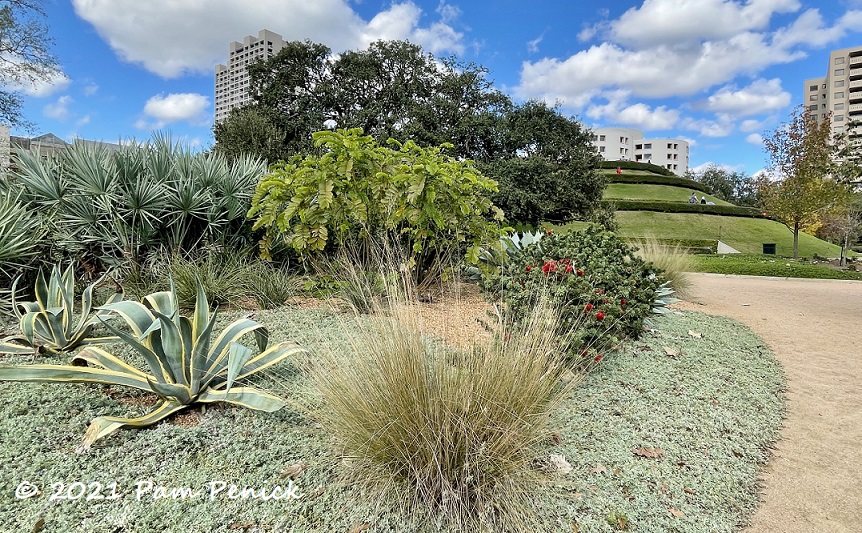
All three of these streetside beds are meant to blend with the island berm I planted two years ago, after pulling out the Asian jasmine groundcover that once swathed the entire bed. The silver-and-gold garden contains ‘Color Guard’ yucca (Y. filamentosa ‘Color Guard’), softleaf yucca (Y. recurvifolia), gopher plant (Euphorbia rigida), Mexican feathergrass (Nassella tenuissima), Mexican oregano (Poliomintha longiflora), foxtail fern (Asparagus densiflorus ‘Meyersii’), bamboo muhly (Muhlenbergia dumosa), Texas dwarf palmetto (Sabal minor), heartleaf skullcap (Scutellaria ovata), ‘Sparkler’ sedge (Carex phyllocephala ‘Sparkler’), Turk’s cap (Malvaviscus drummondii), variegated Miscanthus grass, majestic sage (Salvia guaranitica), silver Mediterranean fan palm (Chamaerops humilis var. argentea), Artemisia ‘Powis Castle,’ copper canyon daisy (Tagetes lemmonii), spineless prickly pear (Opuntia), rosemary (Rosmarinus officinalis), Lindheimer nolina (Nolina lindheimeri), and Texas nolina (Nolina texana). I usually also add annual ‘Senorita Rosalita’ cleome and red cordyline for long-season, drought-tolerant color.


The yuccas are trying to bloom. The deer already ate the bloom spikes of one of my softleafs and my neighbor’s red yucca (Hesperaloe), but I’m hoping to protect this one with deer repellant.


And now I’ve got to protect this little ‘Color Guard’ too as it tries to bloom. Wish me luck!

All material © 2006-2012 by Pam Penick for Digging. Unauthorized reproduction prohibited.

Canyons, river, and sky: Big Bend country (Days 2-3)


Following up on my overall impressions of Big Bend National Park, today I’ll take you on a tour of the sights. Our first morning we drove up into the Chisos Mountains to hike the Chisos Basin Loop Trail. At an elevation of 4,500 feet over the desert floor, and with twice as much rainfall as down by the Rio Grande, the Chisos Basin is a surprising microclimate, with trees like alligator juniper, drooping juniper, Arizona cypress, pines, and oaks. Grasses grow in profusion here too although, as you can see, this area is also suffering from prolonged drought.


Havard agave and juniper


Here’s an agave that bloomed and then died. Its bleached bloom spike still stands…


…unlike this one, which has toppled over.


Mexican feathergrass


I don’t know what these pretty, white seedheads are. Anyone recognize them?


We spotted a few Carmen white-tailed deer in the Basin.


Carmen deer live only in the Chisos Mountains and in nearby mountains in Mexico, isolated here after the last Ice Age, as the surrounding country warmed and turned into a desert.


The Window View is a much-photographed spot.


As the day heated up and the sun grew intense, we spent time driving the park roads and ended up at a boat launch along the Rio Grande. Although signs prohibited it, we couldn’t resist strolling across an ankle-deep section of the river to stand on Mexican soil.


Santa Elena Canyon straddles the border with Mexico. This is the Mexican side of the canyon…


…and on the right is the U.S. side.


The next day we drove to Boquillas Canyon to hike, where I spotted huisache (Acacia farnesiana) in full bloom.


The flowers look like yellow pom-poms.


Just inside the canyon, a steep sand dune beckons the adventurous (and fit) to clamber up the deep, slippery slope, which you almost have to do on all fours. Only my husband made it to the top, along with a father and son from Belton, Texas.


Strategically placed along the trail, little beaded scorpions and roadrunners and carved walking sticks are offered “for a donation for the kids of Boquillas,” with only a collection cup and the honor system. We understood, from prohibitive signs in the parking lot, that Mexicans from the town of Boquillas, visible just across the river, were selling these trinkets to tourists, even though they risk deportation 100 miles away by the U.S. Border Patrol if caught. The signs advised that buying would only encourage the illegal trade and possibly result in the seller’s deportation and confiscation of anything you bought. What a sad situation. Before 9/11, the border between Boquillas and the U.S. was open, and the tourist trade flourished. However, the border crossing was officially closed after 9/11, destroying the Mexican town’s livelihood. According to Wikipedia, most of the residents have had to abandon Boquillas.


The day grew warm, but we headed next to the park’s hot springs, along with more tourists than we’d seen anywhere.


Apparently a dip in a hot pool sounds good even on a hot day. Volcanoes created Big Bend millions of years ago, and there’s still enough heat under the earth’s crust to warm the spring-fed pool.


This nondescript, upright shrub was alive with a deep humming.


Its branches were covered in pretty, purple flowers…


…and hundreds, maybe thousands, of busy honeybees. Does anyone know the name of this desert shrub? This is guayacan (Guaiacum angustifolium). My thanks to David R. for the ID.


Above, the mud nests of cliff swallows adorned the stratified cliff wall along the river.


This would be a fascinating place for a geologist.


Fresh, green mesquite leaves


Back on the road, we spotted Big Bend bluebonnets (Lupinus havardii). They are much taller than the bluebonnets in central Texas, as befits of place of such extremes. In case you’re wondering, all varieties of Texas bluebonnets are officially Texas’ state flower.


Because of the drought, the bluebonnets and other wildflowers were sadly sparse. In wetter springs I’ve heard the desert floor can be colorful.


We left Big Bend on Saturday for the town of Marfa via FM 170, which leads through Big Bend Ranch State Park, the largest state park in Texas. The scenery along the narrow, twisting highway, which climbs through ancient volcanic mountains, was as good as anything we saw in the national park. We stopped to hike Closed Canyon, a narrow slot canyon carved by occasional flooding that leads to the Rio Grande. There had been a thunderstorm the night before, but by the time we arrived the water was gone and a flash flood unlikely, so we hiked in, noting that should water rush in, there would be no escape up the smooth walls of the canyon.


The kids particularly enjoyed this hike. The canyon floor steps down along the way, with increasingly higher drops. Unsure we could get back up, we eventually turned around and hiked back to the car, wondering how the canyon ended: was it a box canyon or open at the end? I found the answer online when I got home: it’s open all the way to the river, but steeper drops near the end may require use of a rope.


Another ocotillo in bloom


Check out those wicked thorns.


The tubular flowers are sure to attract hummingbirds.


A last look back at Big Bend country.

To read my first post about Big Bend and the impact of the drought, click here. Next up: Terlingua’s ghost town and the Starlight Theatre.


By the way, my blog Digging is a finalist for Best Gardening Blog in the Readers’ Choice Awards at About.com. I’d love to have your vote. You can vote once a day (it’s on a 24-hour cycle) until March 21. So vote early and often! Thanks for your support! (And thank you to Pamela Price for the vote graphic.) Click to VOTE.

All material © 2006-2012 by Pam Penick for Digging. Unauthorized reproduction prohibited.

Sharing a garden with a neighbor and ripping out lawn


“After” pics—I’ve got some! When I was having some grass ripped out recently, my neighbor Donna wanted in on the action and took out this big chunk of drought-weary St. Augustine grass at the corner of her driveway, next to my yard. We edged it like mine, with a decomposed-granite parking strip and chopped limestone, added some good Hill Country Garden Soil from the Natural Gardener, and then she set me loose to plant it for her.


Here’s what I planted—just good old tough, deer-resistant plants for Central Texas, including two kinds of grasses for movement, one a spring-bloomer, the other a fall-bloomer; two kinds of salvia and a lantana for color and wildlife; and a ‘Whale’s Tongue’ agave (A. ovatifolia) and Jerusalem sage working with the existing red yucca to provide evergreen interest. I also sowed seeds for narrowleaf zinnia, eryngium, and ‘Fireworks’ gomphrena that I’m hoping will come up in places I left bare of mulch. If you’re wondering about that circle around the agave, I mulched around it with decomposed granite to keep it from rotting. Over time the color variation becomes less noticeable.

Funny story: When I was paying for the ‘Whale’s Tongue’ at Barton Springs Nursery, one of their wonderful employees smiled and asked, “Are you getting another Moby?” Moby is famous! I’ll have to come up with a name for this little one now, I suppose.


Here’s a “before” image for contrast.


Moving to the right, you see the new decomposed-granite path that straddles our property line and meets up with an existing garden bed in my yard. What was formerly a no-man’s-land of thirsty grass is now a useful path that allows us to be in the garden. And doesn’t the space look twice as big as in the “before” picture, below?


“Before”: struggling grass along the street and no invitation into the garden. One of my priorities with any garden is to make sure there’s an invitation to enjoy it.


And how about those marvelous limestone slabs! Lucky Donna to have these in her yard! Don’t they look more natural amid a garden, with decomposed granite lapping up on one side?


They looked lost before, adrift on a sea of lawn. And what a pain to have to mow and edge around them. No more!

All material © 2006-2012 by Pam Penick for Digging. Unauthorized reproduction prohibited.